Twitter

Wednesday, April 16, 2008

What the world sounds like


A map of the world in musical notation, via the ever-wonderful Strange Maps. You can even listen to it performed on piano here. An energetic rush of notes opening on a C major chord and--ending abruptly on a slightly plaintive repetition of high G?

Sunday, April 13, 2008

A week in the life: 6 to 12 April, 2008

Read: vol. 1 of Richard Schomburgk's Travels in British Guiana; Alfred Mendes's and Grace Paley's short stories; misc. reviews of Patrick French's The World Is What It Is; misc. essays in The Art of Literary Publishing, ed. Bill Henderson (this last given me by Georgia, as she clears her shelves in preparation for moving office)

Wrote: emails

Listened: to Ella Fitzgerald (mostly Cole Porter songs), Julie London, Anita O'Day; to a random recording of "In the Bleak Midwinter" (Holst)

Went: to a CRB budget meeting; to the preview of Rachel Rochford's Golden Glance

Acquired: a little two-drawer filing cabinet that just manages to fit under my desk (from Georgia--another welcome hand-me-down from her ex-office)

Ate: Kenny's spicy fried mushrooms; many slices of my mother's bread pudding

Felt: not quite recovered from travel and illness in March; reclusive

Worried: about late copy for the May CRB

Wanted and did not get: a haircut; room for another bookcase

Other highlights: acquisition of a filing cabinet (see above) triggered a short bout of housekeeping, and now the floor of my study is not entirely covered with books, papers, and assorted ephemera

Sunday, April 06, 2008

Then there I was

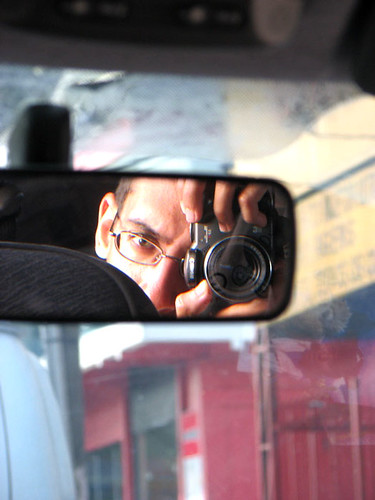
self portrait in manaus traffic

Self-portrait in a taxi, stuck in morning traffic in Manaus; March 2008


More than once during our week in Manaus I caught myself saying I'd wanted to go there ever since I saw Herzog's movie Fitzcarraldo. But that wasn't really true. I'd wanted to see Manaus long before that, probably ever since I first heard of the city in the Amazon, in the middle of the rainforest. I'd imagined the silent unbroken green of the jungle rolling thousands of miles, broken only by rivers and creeks, then suddenly, abruptly, a ring of gleaming skyscrapers around a low hill, church spires bristling, the dome of the opera house shining above plazas and boulevards and gardens, then a great curve of the Rio Negro--and suddenly, abruptly, the forest again, rolling on a thousand miles to the sea.

Of course, it was not quite like that.

We arrived in Manaus on Easter Sunday, not the best day to arrive anywhere. The drive from the airport to the Centro took us through a series of suburbs, laid out like orderly housing estates. Along the highway were billboards advertising banks and insurance companies; we passed a factory for fibreglass swimming pools, with examples of its manufacture displayed on a huge lawn, upturned like monstrous shallow boats.

The skyscrapers, when they appeared, did not gleam. Their paint was peeling and blotched with mildew. Our hotel, just off the Praça São Sebastião, almost in the shadow of the Teatro Amazonas, was like every other small, cheap hotel I've ever stayed in anywhere--cramped, flimsily furnished, smelling faintly of disinfectant. Our room was clean and spare and two of the three lightbulbs worked. We had a wall of windows opening onto a telephone pole knotted with wires and cables, and below that the Rua Dez de Julho. Across the street was an endoscopy clinic.

If anything is happening in Manaus this afternoon, it will be down at the waterfront, we decided, so we strolled down a broad, sloping avenue past shops shuttered and barred, past little kiosks wrapped in tarpaulin and bound with twine like parcels.

The respectable citizens of Manaus were at home, or were sporting in some distant respectable quarter. The crowd at the waterfront apparently had been celebrating Holy Week with gusto. Their revels were not yet ended, but the diminuendo was fading. One or two still managed to dance, or at least sway, to the music slurring from the open-fronted bars. Most were collapsed over tables, slumped across benches, slumped over each other, over cars parked haphazardly in the street.

No one here was young anymore. Everyone had spent too many years working the wrong shifts, drinking too much of the wrong drinks, sweating with the wrong unnamed fevers. A woman of maybe fifty--or maybe forty, with too many wrong stories--dressed in a tight black miniskirt, her dyed-black hair hanging in knots, bent over the handlebar of a motorbike. She was peering into the rear-view mirror, smearing red lipstick over her mouth with an unsteady hand. The motorbike's back tyre was flat.

The gutters reeked of urine and rotting fruit. We turned a corner, past the famous covered market, now boarded up, and there was the river--the Rio Negro, rippled pewter, the far bank a distant black line, and something like a sunset happening behind some clouds.

I shouldn't have come, I thought. I should have let Manaus remain a city of my mind, strange and distant and unknown.

The next day the streets of the Zona Franca teemed with hucksters and hustlers, the little kiosks unbound and unwrapped and offering mobile phone accessories, pirated DVDs, women's underwear, shoes, magazines, and various beauty aids. There was something grimly jaded about all this bustle, all this commerce. No one seemed to smile. Only a rare face showed a hint of freshness. Even the young people--tending their kiosks, hauling bales of goods--seemed already hard-used, coarsened, scarred. I started counting men and women missing an arm--always the left arm, for some reason. Eight, nine, ten.

It was relentlessly hot--what did I expect? This was the tropical jungle--and the fetid air pressed down with the weight of humid, unhappy smells--rotting fish, rotting fruit, rotting river mud. Maybe I was running a fever too, or my blood running thin. I trudged laboriously back to the Praça São Sebastião and took refuge in a small café, and drank frothy lime juice. I thought: I shouldn't have come.

I went back to the hotel, turned up the air-conditioning, and lay staring at the ceiling.

We travel to learn we are wrong.

Thirst drove me outdoors again. It was the cusp of evening. It had rained gently in the middle afternoon, and some of the Easter weekend filth had been washed down the gutters. A breeze had struck up, at last.

In the tropics on lucky fine evenings there is a brief spell, as the sun slips over the horizon, when the sky turns deep violet and the light turns pink, and just like that the whole world and everything in it seems lit up from the inside. Everything glows, every colour is more intense. The world and everything in it seems to pause for benediction. It does not last long.

That evening in Manaus, it seemed to last so long--so long, at last. I was strolling down a narrow street just below the praça. I forgot what I'd left the hotel for--a bottle of cold water. The buildings were now washed with gold and rose, and in that glow you did not notice their mildews and peeling paint. There were trees rustling and whispering, their leaves also lit up--they had been invisible all day until now, in their yards and gardens. There were gardens! Lights were coming on in the houses and shops and cafés. People stepped out of doorways and exhaled, their faces softening. They smiled and chatted, took each other's arms, stepped into the gold and rose dusk.

At the tops of the ugly skyscrapers, even the ugly radio masts were lit up, gilded in the sunset--now they were pinnacles and spires. The cathedral bells pealed as if from a great height. I no longer noticed the direction I was strolling--then as the bells stopped I came out in the square below the cathedral, thronged as if for a holiday with men and women released from the day's labours. The kiosks were strung with lights, the trees were whispering, and through their thick leaves shone the floodlit cathedral on its little hill. Young women strode past in twos and threes, clutching shopping bags. Men loosened their ties and women let down their hair, and they clustered around the gate to a little park, where a vendor sold chunks of beef on wooden skewers from a smoking charcoal grill.

Streaked with scarlet taillights, Avenida Eduardo Ribeiro ascended gently towards the dusk-darkening sky. The shrimp-pink Teatro hovered above the black-and-white waves of the praça, like the backdrop to a stage set. Loudspeakers set demurely among the trees hummed Verdi, and young lovers were already taking their places on the benches, giggling and embracing.

The waiters at the Café do Pensador had put out tables along the praça's southern edge. I sipped a sweet, sticky caipirinha and thought: this is why I came.

Saturday, February 16, 2008

More on the Boissiere House campaign

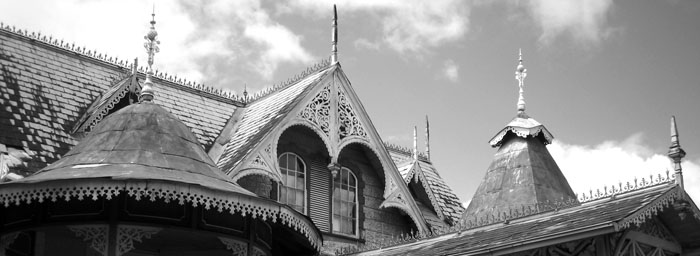
boissiere house roofline

Last I checked, there were 234 names on the online petition requesting government intervention to save the Boissiere House. If you haven't signed yet, please consider doing it now. It takes mere seconds.

On the main SBH page: links to Andre Bagoo's article in today's Newsday and very neat "Save the Boissiere House" badges, designed by Georgia Popplewell, which you can use on your website or blog. They look like this:

save boissiere house

So you've forwarded the website URL to your friends; signed the petition; what else can you do? There's a whole list of suggestions here. Getting media coverage is essential. If you have five minutes to spare, why not call the newsroom of one of the daily papers and ask them to run a story on the house, its architectural importance, and the danger it's in?

Trinidad Guardian: 868-623-8871
Trinidad Express: 868-623-1711
Newsday: 868-623-4929

Better yet, write a letter to the editor. You don't need paper or postage stamp. Just send an email to:

Trinidad Guardian: letters@ttol.co.tt
Trinidad Express: express@trinidadexpress.com
Newsday: online form at http://newsday.co.tt/letterform/

It doesn't have to be a long epistle--the papers like short letters. Just include these key points:

1. the Boissiere House is an architectural treasure and a major landmark, one of just twenty-five buildings identified by the National Trust as worthy of protection
2. it is on the market and in serious danger of being bought by a developer who will demolish it
3. to avert this tragedy, you urge the government to acquire the house and preserve it, and to fast-track the approval of the National Heritage List, which will afford the house legal protection; also you urge the owners of the house to postpone the sale until this "listing" takes place

Most important of all, keep spreading the word that the house is in danger. That's the only way we can build up the critical mass of concerned people it will take to save the Boissiere House.
"We really reach where we have to go...."

An unarmed physicist gets thrown off a barge by three big black men. It’s the stuff of true independence, this. We really reach where we have to go.

Flipper gets slaughtered and many people have expressed concern, but when do we take responsibility for creating a burden on our resources with our growing demands and our ever increasing levels of waste?

I wonder about public servants who get paid to attend conferences where we sign endless international conventions only to result in unarmed physicists being thrown overboard.

Why did we sign the convention on wetlands? What is going on in our education system that is stopping our children who then become our adults from knowing that wetlands are sacred? What are we not doing to ensure that people have different notions of what sustainable economic and human development means?


-- Attillah Springer, in her column in today's Guardian. She sounds angry. Can we all please start getting angry too? Now is the time. The time is now.

Friday, February 15, 2008

Boissiere House update

If you're concerned about the possible demolition of 12 Queen's Park West, the Boissiere House, visit www.saveboissierehouse.org, which has just gone live--there you'll find information about this historic building, a list of things you can do to help save it, and an online petition. Please forward this link to anyone who may be interested.

Also check out this very informative post on Sharon Millar's blog, which explains Trinidad and Tobago's National Trust legislation and the long process of getting a building legally protected. The Boissiere House is on a list of twenty-five key buildings identified by the National Trust for the National Heritage List, but certain legal procedures must be fulfilled before the list is made official (and the house is legally protected). There are efforts underway to fast-track the listing of the Boissiere House, since it is under urgent threat. What can we do to put pressure on the Ministry of Culture to get this done?

Thursday, February 14, 2008

Can we save the Boissiere House?
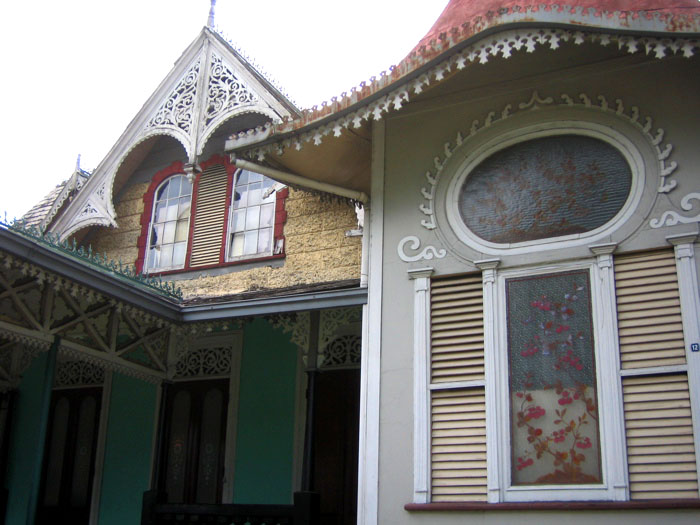
boissiere house front

Detail of the front facade of the Boissiere House at 12 Queen's Park West. Note the ornate fretwork of the main gable to the left, and the detailing, including painted glass windows, of the "Chinese pavilion" study to the right.

There are so many things to be anxious or angry about in this country these days--crime, corruption, smelters, steel mills, dolphin-slaughter, traffic--that the fate of an old house may seem trivial.

But 12 Queen's Park West, the Boissiere House, is not just an old house. It is a gorgeous example of the late Victorian gingerbread style that was once typical of Port of Spain. It is a major city landmark, familiar to tens--even hundreds--of thousands, and known to many simply as "the Gingerbread House". It is the ultimate creole house, part Amerindian ajoupa, part French chateau, part Chinese pagoda, built with the sweat and labour of forgotten ancestors. It is a national architectural treasure:

It is also, I am afraid, in peril.

Why? Because after remaining in the Boissiere family for 104 years, since it was built in 1904, it is now being offered for sale, at a price of TT$50 million. Any private buyer willing to pay that will almost certainly bulldoze it and build an office block or posh condominiums to recoup their investment.

We've seen this happen so many times before. Just in recent years we've lost the Lee House on St. Clair Avenue, Bagshot House in Maraval, the Union Club on Independence Square, Coblentz House in St. Ann's, and numerous smaller gingerbread houses all over the city. Just a couple months ago, the big orange Pierre house on the Roxy roundabout disappeared, after years of neglect. The Trestrail Building on Broadway, with its cool, understated Corinthian columns, was bulldozed to build another yet office tower.

The architect Edward Bowen designed the Boissiere House with its ornate fretwork -- described 25 years ago by John Newel Lewis as "the finest remaining example in Trinidad" -- its study in the form of a tiny Chinese pavilion, its painted glass windows, and its gesso-work ceilings. It is Bowen's masterpiece, and one of the dozen or so most important buildings in Port of Spain, in the same league as the Magnificant Seven, Knowsley, the Red House, the two cathedrals, and the Cabildo. Though the house and land on Queen's Park West are the property of a private owner, it is also, surely, after 104 years, part of our common heritage.

But with all those other things to be anxious or angry about, all the ills and inequalities of our society, is it really worth getting upset about losing the Boissiere House? I think it is. Because this is a line in the sand, a test of how mercenary and philistine we really have become. Contemporary Trinidad seems hell-bent on destroying everything we have that is beautiful and authentic, usually in the name of the dollar. We knock down gorgeous old buildings, erase their history and stories and memories, and build air-conditioned Miami-boxes. We pave our green open spaces. We drown true mas in floods of sequinned bikinis imported from China. The works of art in our National Museum are literally crumbling from neglect (when last did you go and look at them?). Most of our musicians can't get airplay (when last did you hear jointpop on the radio?). At some point will we say, enough is enough?

Could this be that point?

So what might we do? There seems to be only one realistic option: persuade our government that the Boissiere House is a crucial and irreplaceable part of our national heritage, that it must be bought by the state, restored, and put to appropriate public use.

$50 million is a lot of money. But we can afford to build skyscrapers--ugly ones--and prime ministerial palaces, and buy droning blimps, and build white elephant cricket stadiums, and our prime minister can afford to hire a crack team of private security agents. We have, frankly, more money than we know what to do with.

Can we afford to save this one, beautiful old house--just because it is beautiful, because it makes our increasingly ugly city a little easier to live in? Because it brings a moment of pleasure to everyone jogging round the Savannah or stuck in traffic on Queen's Park West? Because it represents our history, and our collective memory, and that is something no one can put a price on?

I am going to do all I can. Other concerned citizens are already working quietly to save the Boissiere House. I think it's time to stop being quiet. If you want to help, here are some simple, practical suggestions:

- Tell people the Boissiere House is in danger.
- Forward this blog post to everyone you know who might be concerned.
- If you have a blog, write your own post there, or link to this.
- Write a letter to the editor.
- If you work in the media, try to get your newspaper or station to run a story.
- If you own a camera, stop by 12 Queen's Park West, take some photos, post them online, or just forward them to friends. Here are mine.
- If you know someone in the Ministry of Culture, tell them you're concerned and ask them to speak to their superior about saving the Boissiere House.
- Call Town and Country and urge them not to give planning permission for a new building on this site.
- Call the National Trust and ask what you can do to help.
- If you know a politician of any party on any level, tell them you're concerned and ask them to talk to their party leadership.
- Read about the history of the house in Olga Mavrogordato's book Voices in the Street, or John Newel Lewis's book Ajoupa, and share this with others.
- Come to the event we're planning at Alice Yard next week Friday to discuss why this and other historic buildings are worth preserving.
- Email me (my address is in the sidebar to the right) and tell me you'd like to be on a mailing list to hear about further efforts. A website is on its way, also an online petition.
- If you know a member of the Boissiere family that owns the house, ask them to consider putting a no-demolition clause in the sale contract, or to negotiate with the government to arrive at a reasonable sale price that might make it easier to save the building.
- And if you are a multi-millionaire property developer, consider doing something truly enlightened: buy the house, pay to have it restored, put it to some use that will not damage its fabric.

Finally: ask yourself if you'd be willing to stand in the hot sun with a placard, if it comes to that.

boissiere house painted glass

Detail of the painted glass windows in the study of the Boissiere House.
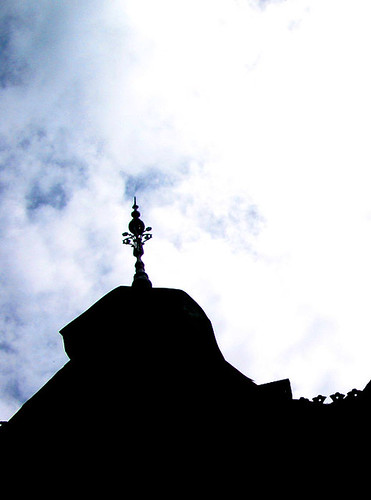
boissiere house pagoda finial

The iron finial on the roof of the "Chinese pavilion".

Monday, February 11, 2008

And that was my Carnival

nicholas jouvert 2008 1

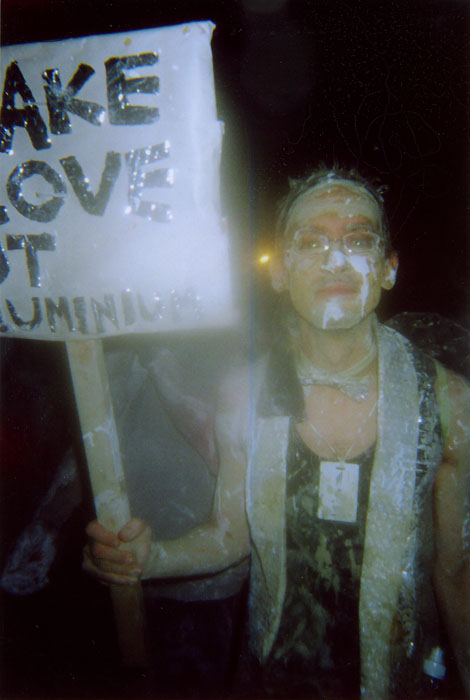
Soft-focus effect thanks to mud smeared on the lens of the not-so-cheap disposable camera.

This is me roughly a week ago--J'Ouvert morning, c. 5 a.m., probably still on Ariapita Avenue. The "band", such as it was, was called Industrialise Dis!--yes, we had a green theme, thanks to Attillah--about twenty of us, coming out of Alice Yard, in Cumuto mud and costumes made from recycled and discarded materials. My own quite dapper costume consisted of a vest and bow-tie made from old insulation foil, a pair of wings (wire, newspaper, black paint), and a placard reading "Make Love Not Aluminium". 3Canal let us infiltrate their band, Shine, and we jumped up with the Laventille Rhythm Section till the sun was well in the sky. Then I took a little dip at Macqueripe to wash off most of the mud and paint, and fell into my bed--where I dozed through the rest of Carnival.

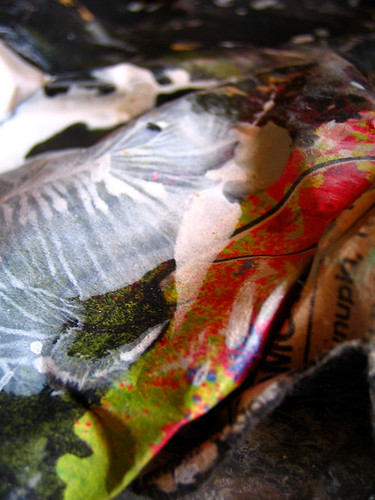
jouvert abstract

Close-up of the mud and paint spatters on my J'Ouvert wings--it pretty, eh?

Monday, January 28, 2008

On not eating meat

I am not the preachy sort of vegetarian. If asked, I'll explain the humanitarian and ecological reasons behind my decision to stop eating meat nearly six years ago. I'll also tell you that I found it surprisingly easy to do, despite my previous reputation as a full-blooded carnivore. But I won't try to guilt-trip anyone (OK, maybe just in fun, among friends), or object to others eating meat in my presence, or pretend to be disgusted. I always tell dinner hosts that I'm happy to eat around a main course of flesh, and when travelling in vegetarian-unfriendly parts of the world I've managed to subsist for days, more or less cheerfully, on repetitive meals of plain rice and sliced tomatoes.

But this article by Mark Bittman in yesterday's New York Times summarises so succinctly the good reasons to stop eating meat--or at least reduce the amount one eats--that I can't resist pointing to it. I encourage those of my carnivore readers who worry (as I do) about global hunger and malnutrition, disappearing rainforests, global warming, water pollution, and animal suffering to read it and consider how hard or how easy it might be to go vegetarian even one day a week, and the possible good it might do.
No answers, no fix, no plan....

The time has come for a reckoning. Let the slaying of the Lusignan 11 marshal all of our efforts. It is also time for the government, in particular the President and the Minister of Home Affairs to drop the pretence. The security situation is not under control. Within five hours there were two chilling attacks. The country's police headquarters in the capital came under unanswered gunfire and hours later 11 persons were slaughtered on the East Coast with the police putting in their usual late appearance. Anytime 20 to 25 men can storm a village and kill with impunity it rips to shred the pantomimes and fairy tales about crime being reasonably under control. It is a deception of magnificent proportions and has been routinely conjured up by President Jagdeo and his administrations.

The President and his administration have no answers on crime, have no fix on what is happening and have no plan to implement. President Jagdeo must take personal responsibility for this situation. With nearly a decade of increasingly autocratic rule he has failed to conquer crime and has caused a worsening of the situation by not tackling major menaces such as the drug cartels, narco-terrorism and money laundering. He has failed to launch adequate investigations of shocking crimes such as the assassination of one of his own ministers, the mayhem and brutality inflicted on East Coast communities, the unsolved murders of dozens of men, the reign of the death squads and the possible involvement of one of his ministers with the death squads. Notwithstanding this he quite opportunistically announced a major probe following the discovery of two weapons alleged to be linked to the PNC from the 1970s. Exceedingly strange.

What is now in the government's game plan is anyone's guess. The plodding citizen's security initiative and the still inchoate British anti-crime plan promise much but have not yet delivered. There has been much prating about the crimestoppers programme but no stopping of crime and the so-called drug master plan is being mastered by the cocaine barons and their minions.

More radical options should be contemplated and which options have been urged for at least the last 15 years i.e. recourse to crime fighters from professional bodies such as Scotland Yard and a thorough shake-up of the police and the installation of new leadership.


--From the editorial in today's Stabroek News.

Sunday, January 27, 2008

Heart of darkness

The massacre of eleven men, women, and children in Lusignan--in the middle of the night, while most of them were in their beds--is the kind of horrific event that newspaper reports describe as "senseless". They were gunned down, it seems, on the orders of Rondell Rawlins, "Guyana's number 1 fugitive", a notorious gang leader already wanted for the 2006 murder of agriculture minister Satyadeow Sawh and others. As the Stabroek News succinctly puts it:

The assault on the community comes in the wake of reports from the police that ... Rawlins had contacted ranks at the Criminal Investigation Department headquarters on Wednesday threatening to create mayhem if his alleged child mother--Tenisha Morgan who went missing since Friday last was not returned safely. Stabroek News was told that the gunmen in Buxton are of the view that the pregnant teenager was abducted in an effort to get at Rawlins, who is believed to be the leader of the Buxton/Agricola criminal gang.

So a squad of heavily armed men dressed in black descended on Lusignan and went house to house shooting everyone they found, including terrified children clinging to their mothers.

But in a profoundly revolting way, the Lusignan murders were not senseless at all. They are the logical next step in the civil war raging in Guyana, no less a war for not being recognised by the rest of the world. By Caribbean standards, Guyana has long been a specially murderous place, and one of the hardest things for outsiders like me to understand is how this tendency towards violence can be squared with the gentleness and hospitality of most ordinary Guyanese. But the killings of past decades were not like this. Assassinations of political activists, yes; reprisals against individuals or communities; or old-fashioned stab-and-grab robbery-murders. But the people of Lusignan were not opponents of the Rawlins gang in any conventional sense, and robbery was not the motive. This is something new for Guyana: a quick, easy civilian massacre as a simple demonstration of power. I don't believe, and I suspect most Guyanese don't believe, that the "authorities"--an ironic word to use here--could have prevented the massacre even if they knew it was going to happen. This could well be the tipping point in the war between an encreasingly enfeebled government and an increasingly well-armed and confident criminocracy.

Caught in the middle--no longer merely imperilled by stray bullets, but directly targeted--are the people of Guyana and what bureaucrats like to call "civil society": impoverished, demoralised, terrified. Almost every smart, ambitious Guyanese who can manage it leaves. That's why there are more Guyanese in the New York City metropolitan area than in Guyana. That's why there are so many Guyanese in Toronto, London, Barbados, Trinidad--anywhere they can escape to. And the bright, ambitious Guyanese who have not yet escaped--those whose idealism or patriotism keeps them in their homeland, those who have not yet been lucky enough to get a green card--will never again be numerous enough to constitute the critical mass of educated, civic-minded citizens that every society requires to survive.

I am one quarter Guyanese--my mother's father was born there. I have friends there. I have spent enough time in Guyana to feel a real attachment to certain places, certain ideas, certain hopes. I am trying today to remember what those hopes might be. Instead I feel--I imagine most Guyanese today are feeling--a horrible, sickening despair. I have felt it before--reading about the Sawh murders, the attack on the Kaieteur News workers in August 2006, and various other bloody acts. I have felt it on the streets of Georgetown, so many times, so that as much as I've enjoyed my visits there, I always leave deeply depressed. I've never felt so utterly hopeless about Guyana as I do today, and it weighs all the heavier in this prolonged season of hopelessness about my own country, my own society.

I am afraid Guyana is beyond saving. Afraid not in the rhetorical sense--"I'm afraid it looks like rain"--but in the literal, visceral sense.

Maybe nature will intervene, and some vast disaster, compounded by grossly inadequate emergency services, will inundate the narrow coastal strip, decimate the population, and trigger a humanitarian response from the world.

Maybe someone, somehow, will find natural gas off the coast in undisputed waters; American, British, and Canadian commercial interests will move in, and--what? Our natural gas seems to be leading Trinidad and Tobago down the path to perdition. How could it be any different for Guyana?

Maybe no one will ever find oil or gas, and the Americans and the British will continue to do, essentially, nothing helpful (despite the fact that so many of Guyana's problems today can be traced directly back to the political destabilisation wilfully effected by the British and American governments in the fifteen years before Guyana's independence in 1966, in the name of anti-communism). Yes, the ambassadors in Georgetown said all the right things yesterday, but the new EU trade deal will hit Guyana harder than any other Caribbean territory, foreign "aid" will never make up the deficit, and it always comes with strings attached. How many of Guyana's aid packages require that the government hire foreign consultants to staff the ministries--foreigners who get paid relatively huge salaries, live in Georgetown's best neighbourhoods, and are airlifted out after their two-year tours-of-duty; while possibly qualified Guyanese who might be filling those same roles consequently have even fewer possibilities for employment, and hence fill out their green card applications all the speedier? Yes, when I go to Guyana I too am a foreigner. Yes, there are decent, concerned, dedicated women and men among the expat squads who really do want Guyana to be a viable state, who really do want to help. Yes, the alternative to this kind of "aid" might be an even more rapid and bloody social collapse. But it must be a crisis of some kind when a country's most able citizens flee, never to return, while civil infrastructure is increasingly supported by foreigners on short-term contracts.

So maybe it will be one of Guyana's neighbours that finally, decisively, steps in. No Caricom state has the willpower to do it, and only one--Trinidad and Tobago--might have the financial resources, but the Manning government is too busy failing to check the rise of our own criminocracy. That leaves Guyana's neighbours to the west and south. In that case, pray it is not Venezuela but Brazil that finally acts, and pray it is not an invasion but a negotiated political deal--a massive security presence plus massive infrastructural investment in return for Georgetown or Parika becoming Brazil's northernmost port.

And if there is no external intervention, either from nature or from a foreign power? The balance of power will continue to shift from elected government to narco-criminocracy, and it is only a matter of time until the state fragments and thousands more defenseless Guyanese are slaughtered.

Someone, anyone, tell me I'm wrong. Please.

And tell me what to do.

Saturday, January 26, 2008

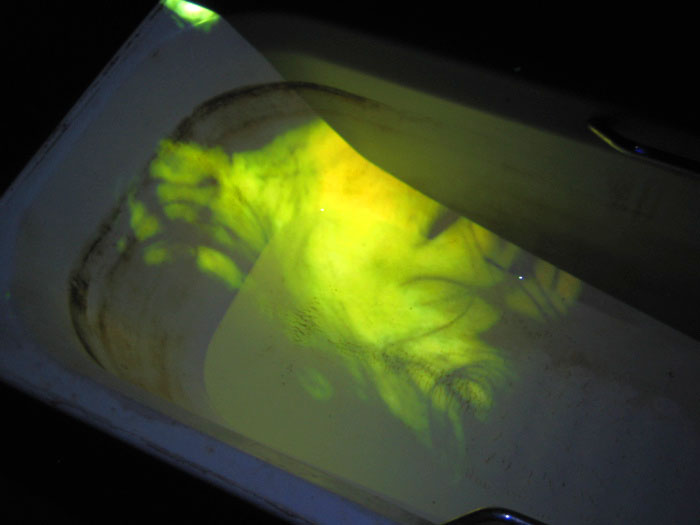
Inside the little house ...

la fantasie interior 4

... at 43 Norfolk Street ...

Friday, January 25, 2008

"The bottom line in the road"

For years now, most "Trinidad" Carnival costumes have been made in China and shipped complete to Trinidad in the very cardboard box you're handed when you reach the mas point of sale. (You can't in conscience call these retail outlets "mas camps".) All the bands do is write your name in felt pen on the box and hand it to you-and if we could read Chinese characters, they wouldn't do even that, but would just take your cash. And if there's more than TT$20 worth of merchandise in your hands after the handover-including the firetrucking cardboard box-the bandleaders are robbing themselves, just robbing themselves!...

In that context, there really need be no debate about whether Carnival should be moved since it is all but irrelevant to itself and could take place on any day of the year. Or none. People foolish enough to believe Carnival still has anything to do with harnessing a people's creativity and releasing their love for life and one another are few and can safely be dismissed, like the Rights Action Group smelter protestors who will walk and whine from the NEC HQ to Pranz Gardens tomorrow. (Call Priya 328-4153.)

Trinidad is no longer the Land of the Hummingbird but the Land of the Cash Cow.... In the new Trinidad Carnival, the only thing that need be considered is not the bottom in the road but the bottom line in the road; and the empty chanting that has replaced Trinidadian music is the plainest illustration of that.


-- B.C. comes in swinging.

Thursday, January 24, 2008

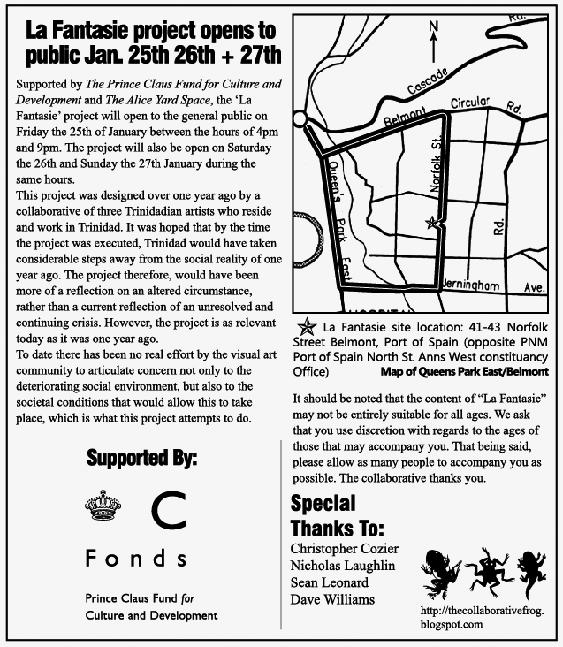
La Fantasie on Norfolk Street

la fantasie announcement

Wednesday, January 23, 2008

18 months, 2 weeks, 5 days

4 July, 2006: first meeting to discuss new (completely re-transcribed, expanded, re-annotated) edition of V.S. Naipaul's early family correspondence

28 November, 2006: signed contract

23 January, 2007: first of three days at the Naipaul archive, McFarlin Library, University of Tulsa

23 January, 2008: emailed finished manuscript (249 letters, 273 pp, approx. 130,000 wds) to publisher

(Phew!)

(Back to "Imaginary Roads"....)

Saturday, January 19, 2008

Carnival is over

So this is how it ends: with neither a bang nor a whimper, but a meeting of "stakeholders". This is the logical and utterly depressing conclusion of Carnival's mercenary debasement over the last two decades: representatives of Pan Trinbago, TUCO, the NCBA, and the NCDF want to "set Carnival to a permanent fixed date in April" because "Carnival is now an industry and like any other it needs regulating". These are the same people who have cut Carnival off from its community roots in the name of corporate sponsorship, pushed spectators off the streets and corralled masqueraders behind cordons in the name of security, suffocated real creativity in the name of profit margins, and are hell-bent on making Carnival the preserve of tourists and the comfortable middle class. Now they want to efface Carnival's ritual and historical roots in the name of convenience and efficiency, just as the PNM culture ministry effaced the Savannah barbergreen.

Minshall said it already: This Is Hell.

Wednesday, January 16, 2008

On being restless

... variety of actions, objects, air, places, are excellent good in this infirmity and all others, good for man, good for beast.... peregrination charms our senses with such unspeakable and sweet variety that some count him unhappy that never travelled, and pity his case that from the cradle to his old age beholds the same still; still, still the same, the same....

--Thomas Browne, from The Anatomy of Melancholy, 2nd part., sec. 2

***

Consulting maps, assembling charts, drawing calendars; making lists of border towns, searching out accomplices' addresses; phrasebooks, timetables, gazetteers; a milky blue lake set among mountains; anthills along a red earth road; a river that bounds the known world....

"From here," he said, waving across the rice paddies, "It is straight to Argentina."

Wednesday, January 09, 2008

Target: TSTT

Take cover, Georgia is on the warpath....

Monday, January 07, 2008

Laying plans

Aha: so I suspected.
The maps are blank.
Librarians have sat up through the night
erasing. Ants have been at work.
The border guards are keen on confiscation,
their messrooms are papered with pages from travellers' journals.
(A.: Am I the only one not worried?)
"Presentando Nicholas. Show him a good time,
if you know what I"--wink to the barman--"mean."
"I can be a good help for him."
"Everyone at least keeps three or four passports.
You better too."
(A.: I am undecided--malaria pills?)

Friday, January 04, 2008

A year's reading

My two or three longtime readers may recall that for five years running (2002-06) I engaged in a semi-serious little exercise called the Nicholas Laughlin Book Awards (see appropriate links in the sidebar to the right), in which I listed what I thought were the best Caribbean books of the preceding twelvemonth, always accompanied by profuse caveats. Were I to keep up the tradition, I'd be announcing the 2007 version of the NLBAs just about now. Instead, I've sort of stolen my own thunder, over at Antilles--where, a few days ago, I posted the names of the 2007 CRB books of the year, as collectively chosen by the magazine's editors.

Everyone else does year-end lists, I thought, so why not us? So I asked the CRB's contributing editors what they thought were the outstanding Caribbean books of the year and collated the results--no one of us can read everything, but collectively I hope we managed not to miss any truly remarkable new titles. There were nine books on the final list: two novels, a collection of short stories, two collections of poems, two memoirs, and (intriguingly) two books on art history. They were written by two Jamaicans, a Bahamian, a St. Lucian, a Grenadian who lives in the US, a Trinidadian, a Dominican-American, a Haitian-American, and a team based at Yale. One of our rules of thumb was that all the books on the list must be of interest to general readers across the Caribbean--thus excluding scholarly books (however excellent) relevant only to specialists. Two of the books--the art history titles--are by academics and published by university presses, but both are accessibly written and have much to offer those of us outside the field who happen to be interested in what visual documents can tell us about Caribbean history and culture.

These nine were the standouts--you may as well read the list before you continue here--but of course they weren't the only noteworthy books of 2007. Editing the CRB means that I receive and skim through perhaps 150 books a year. About sixty of these get despatched to reviewers, and a few dozen more are "noticed" in our "Also noted" column. I simply don't have the time to read as many of these new titles as I'd like--who does?--but a good few make it into my own personal "to read" pile. The new Caribbean books I've enjoyed reading or have put aside for reading in due course include:

- Sharon Leach's book of stories What You Can't Tell Him, one of the year's nice surprises; life in contemporary Kingston as lived by a series of middle-class women trying to balance career, romance, and sanity, and figure out what success means. Someone described the book to me as "Sex in the City, but Jamaican", but that's not really apt--these stories are too melancholy, clear-eyed, truthful.

- V.S. Naipaul's book of linked essays A Writer's People--always interesting, always a must-read, but frustratingly self-involved, like so much recent Naipaul. It won't ever be a favourite, but it did send me back to his earlier work. (I think I was thoroughly over-Naipauled in 2007.)

- New Caribbean Poetry, the anthology edited by Kei Miller, featuring poems by eight younger poets from across the region, including a couple who were completely new to me, and whose work I'll be following carefully from now on.

- Raymond Ramcharitar's first book of poems, American Fall, which I'm glad and relieved has finally been published. I'm even more interested to read whatever he writes next. (Raymond is no fan of the CRB, as anyone who reads his now-hibernating blog already knows; I agree with him about many things, disagree about many more; but he's an often brilliant writer and one of the most intriguing public intellectuals--if such a term has any currency here--Trinidad has produced in a generation.)

- Also Kwame Dawes's memoir A Far Cry from Plymouth Rock; Anthony Jospeh's long prose-poem The African Origins of UFOs, which I heard him read from in August; and Meiling, an elegant, understated biography by Judy Raymond. Madison Smartt Bell's biography of Toussaint L'Ouverture is a to-read. Three art books I'm pleased to have on my shelf: the catalogue of Infinite Island; The Storyteller, a concise retrospective of Roberta Stoddart's career; and Cuba Avant-Garde, the catalogue of an exhibition of contemporary Cuban art from the collection of Howard and Patricia Farber.

What am I looking forward to in 2008? New novels by Marlon James and Kei Miller; Patrick French's biography of Naipaul; Edward Baugh's biography of Frank Collymore; a new book of poems by Vahni Capildeo; Ian McDonald's Selected Poems; a young adult novel by Lisa Allen-Agostini; Anu Lakhan's book on Trinidad street food. (Also, frankly, my own new edition of Naipaul's early family correspondence.)

What was my great belated discovery in 2007? The work of Alejo Carpentier, especially Explosion in a Cathedral and The Lost Steps. (Thanks to my friend Anne Walmsley for inadvertently encouraging me to pluck from the shelf my long-ignored copy of the former.)

What were the highlights of my non-Caribbean reading last year? I seem to read fewer and fewer new books. Michael Chabon is one of my favourite living writers and I felt I'd been waiting forever for his new novel, The Yiddish Policemen's Union (which sent me back to re-read his three earlier novels). I can't believe I waited so long to read The Road to Oxiana, which is now one of my touchstones--and why are the rest of Robert Byron's books out of print? After years of resisting the charms of Gabriel García Márquez, I finally gave in. I continue to delve into obscurer aspects of the history and landscape of Guyana, and was arrested some months back by Graham Burnett's brilliant Masters of All They Surveyed, a study of nineteenth-century surveying, map-making, boundary-drawing, and Robert Schomburgk. I spent the last days of the waning year in the agreeable company of Jan Morris. At Marlon James's insistence, I at last read Orhan Pamuk's My Name Is Red, and was glad I did.

Concise version?

Book of the year, Caribbean, new: The Brief Wondrous Life of Oscar Wao, by Junot Díaz

Book of the year, non-Caribbean, new: The Yiddish Policemen's Union, by Michael Chabon

Book of the year, Caribbean, non-new: Explosion in a Cathedral, by Alejo Carpentier

Book of the year, non-Caribbean, non-new: The Road to Oxiana, by Robert Byron

Writer of the year: Robert Byron.

On! on!