“Before this was a poem it was a question”
“Here Is the Poem”, published today in tongues of the ocean.
Sunday, August 23, 2009

Monday, August 17, 2009
Monday, August 10, 2009
“A memory of anticipation”
What should young or emerging poets be doing that you don’t see them engaged in at present?
The basic mesmeric quality of poetry is rhythm. And rhythm means memory. I don’t think a lot of young writers write for memory.
Do you mean that they don’t write so they will be remembered?
No. The thing about a poem when it’s good is that you can feel as if you know it as you read it. So there is a memory of anticipation that is confirmed by the poem. And I think a couple of generations have been lost through a kind of anarchic attitude to meter that tells the young poet to “go ahead” because they might have an interesting personality, etc. etc.
-- Derek Walcott, interviewed in the August 2009 issue of The Wolf.
What should young or emerging poets be doing that you don’t see them engaged in at present?
The basic mesmeric quality of poetry is rhythm. And rhythm means memory. I don’t think a lot of young writers write for memory.
Do you mean that they don’t write so they will be remembered?
No. The thing about a poem when it’s good is that you can feel as if you know it as you read it. So there is a memory of anticipation that is confirmed by the poem. And I think a couple of generations have been lost through a kind of anarchic attitude to meter that tells the young poet to “go ahead” because they might have an interesting personality, etc. etc.
-- Derek Walcott, interviewed in the August 2009 issue of The Wolf.
Friday, August 07, 2009
Amours de voyage, pt. 1
Night after night I dream of journeys,
I never know the names of these cities,
or my companions, or what are my duties....
*
"I came all this bloody way
to be mocked by the border guards."
"That accent--he tries too hard."
*
Enclosed: a little crocodile
preserved in native brandy.
Three bees pickled in wine.
Forty-odd new species of fish,
none of them yet named.
*
"I was brought up to speak and write the English tongue."
Night after night I dream of journeys,
I never know the names of these cities,
or my companions, or what are my duties....
*
"I came all this bloody way
to be mocked by the border guards."
"That accent--he tries too hard."
*
Enclosed: a little crocodile
preserved in native brandy.
Three bees pickled in wine.
Forty-odd new species of fish,
none of them yet named.
*
"I was brought up to speak and write the English tongue."
Sunday, August 02, 2009
Saturday, August 01, 2009
Things people leave behind in books
= Receipt for "1 knife", Curaçao, 1971
= letter beginning "Dearest David, / I am returning the beautiful necklace you gave me", 2000
= ticket to a dinner and dance hosted by the Dreizpitzer Bowling Club, the Bronx, 1966
= note explaining that a "MINI JOB-- / is any job--project regardless of how frequently it should be done that takes / 10 minutes or less / to complete"
= photograph of a bush-pig
Etc.
(Things I have found in books: Christmas cards; a cinema ticket; a photograph of a Barbados hotel, c. 1940; a letter written from the United Nations conference in San Francisco in 1945; a somewhat famous poet's British Airways boarding pass; a banknote; several squashed insects.)
(Things I know I've left in books: bus and train tickets; magazine subscription cards; book review notes; newspaper clippings; a paper napkin with someone's phone number written on it; ivy leaves from Drumcliff churchyard, co. Sligo, Ireland.)
= Receipt for "1 knife", Curaçao, 1971
= letter beginning "Dearest David, / I am returning the beautiful necklace you gave me", 2000
= ticket to a dinner and dance hosted by the Dreizpitzer Bowling Club, the Bronx, 1966
= note explaining that a "MINI JOB-- / is any job--project regardless of how frequently it should be done that takes / 10 minutes or less / to complete"
= photograph of a bush-pig
Etc.
(Things I have found in books: Christmas cards; a cinema ticket; a photograph of a Barbados hotel, c. 1940; a letter written from the United Nations conference in San Francisco in 1945; a somewhat famous poet's British Airways boarding pass; a banknote; several squashed insects.)
(Things I know I've left in books: bus and train tickets; magazine subscription cards; book review notes; newspaper clippings; a paper napkin with someone's phone number written on it; ivy leaves from Drumcliff churchyard, co. Sligo, Ireland.)
Friday, July 24, 2009
Friday, July 17, 2009
To El Paují
6 April, 2007
We thought getting to El Paují would be a simple move, but not on Good Friday. After breakfast we went round to pay our daily call on Andreas at his workshop, where he seems permanently occupied making chairs, and he advised us to arrange our transport at once. In the sawdust on his workbench he drew us a map to the Gran Café, across from which the Asociacion Civil de Toyoteros de Santa Elena was packing Land Cruisers with passengers and luggage.
No, we wouldn't be ready in time to take a shared vehicle. So we'd pay twice as much to hire our own. We negotiated with four different men with no English among them and strong accents which made their Spanish hard to follow. Finally an older man with grey hair, a bulbous nose and a frown--if there was a boss it was he--took over. I wrote our request in my notebook, and the price, and showed it to him, to avoid misunderstanding.
On our way back we were accosted as usual by the moneychangers at Four Corners, the intersection of Calle Urdaneta and Calle Bolívar. Since last week we've been changing our dollars with the same man, who works out of a small office at the back of an arepa shop. The rate has gradually declined from 3,600 bolívares to the dollar last week to 3,500 two days ago to 3,400 this morning--the dollar keeps falling, he tells us cheerfully, bajo, gesturing with both hands.
After lunch we returned to the Asociacion Civil de Toyoteros, where our driver Ricardo and this morning's grey-haired bossman were affixing a new sticker to the Land Cruiser with a damp sponge. We piled in our bags, put B.--still feeling delicate--in the front passenger seat, and the rest of us perched on narrow ledges in the back cabin of the vehicle. We headed off, south, in the direction of the airstrip.
At the military checkpoint there, a soldier made us pull off the road. We couldn't follow his conversation with Ricardo. We began to fumble for our passports. Ricardo jumped out, came round to the back of the Land Cruiser, opened the door. A young soldier peered in. I put my notebook away. Suddenly a large box of groceries--coffee, sugar, cooking oil--was thrust in, followed by two big plastic sacks of frozen meat, followed by the young soldier. We were giving him a lift.
Private Jamarillo asked if we had cigarettes. We didn't. He asked if we were Spanish. He must have been eighteen or nineteen, with melancholy eyes, sharp crewcut, and a little pout. He told us El Paují was good for taking photos. Then he tried to fall asleep.
Half an hour outside Santa Elena the paved road ended and we were driving on red earth. Every few minutes Ricardo would crash over a bump or rut as if trying to achieve flight. One particularly giant crash sent me almost into O.'s lap and Private Jamarillo almost into his box of groceries. I tried a witticism. "Espero que no hay huevos." He chuckled politely and tried to return to his nap.
Another half hour passed. Then just before El Paují we stopped at another checkpoint, where Private Jamarillo and his rations alighted. An exceedingly stern officer looked at our papers. O. asked to use the baño and chivalrous Private Jamarillo showed her the way. She returned horrified by whatever she found there. B. asked for the baño also. The officer nodded in the direction of the northern horizon, broken by distant tepuis, and laughed. "Señor," he said, "La sabana es muy grande." B. hobbled off into the long grass beside the red road.
6 April, 2007
We thought getting to El Paují would be a simple move, but not on Good Friday. After breakfast we went round to pay our daily call on Andreas at his workshop, where he seems permanently occupied making chairs, and he advised us to arrange our transport at once. In the sawdust on his workbench he drew us a map to the Gran Café, across from which the Asociacion Civil de Toyoteros de Santa Elena was packing Land Cruisers with passengers and luggage.
No, we wouldn't be ready in time to take a shared vehicle. So we'd pay twice as much to hire our own. We negotiated with four different men with no English among them and strong accents which made their Spanish hard to follow. Finally an older man with grey hair, a bulbous nose and a frown--if there was a boss it was he--took over. I wrote our request in my notebook, and the price, and showed it to him, to avoid misunderstanding.
On our way back we were accosted as usual by the moneychangers at Four Corners, the intersection of Calle Urdaneta and Calle Bolívar. Since last week we've been changing our dollars with the same man, who works out of a small office at the back of an arepa shop. The rate has gradually declined from 3,600 bolívares to the dollar last week to 3,500 two days ago to 3,400 this morning--the dollar keeps falling, he tells us cheerfully, bajo, gesturing with both hands.
After lunch we returned to the Asociacion Civil de Toyoteros, where our driver Ricardo and this morning's grey-haired bossman were affixing a new sticker to the Land Cruiser with a damp sponge. We piled in our bags, put B.--still feeling delicate--in the front passenger seat, and the rest of us perched on narrow ledges in the back cabin of the vehicle. We headed off, south, in the direction of the airstrip.
At the military checkpoint there, a soldier made us pull off the road. We couldn't follow his conversation with Ricardo. We began to fumble for our passports. Ricardo jumped out, came round to the back of the Land Cruiser, opened the door. A young soldier peered in. I put my notebook away. Suddenly a large box of groceries--coffee, sugar, cooking oil--was thrust in, followed by two big plastic sacks of frozen meat, followed by the young soldier. We were giving him a lift.
Private Jamarillo asked if we had cigarettes. We didn't. He asked if we were Spanish. He must have been eighteen or nineteen, with melancholy eyes, sharp crewcut, and a little pout. He told us El Paují was good for taking photos. Then he tried to fall asleep.
Half an hour outside Santa Elena the paved road ended and we were driving on red earth. Every few minutes Ricardo would crash over a bump or rut as if trying to achieve flight. One particularly giant crash sent me almost into O.'s lap and Private Jamarillo almost into his box of groceries. I tried a witticism. "Espero que no hay huevos." He chuckled politely and tried to return to his nap.
Another half hour passed. Then just before El Paují we stopped at another checkpoint, where Private Jamarillo and his rations alighted. An exceedingly stern officer looked at our papers. O. asked to use the baño and chivalrous Private Jamarillo showed her the way. She returned horrified by whatever she found there. B. asked for the baño also. The officer nodded in the direction of the northern horizon, broken by distant tepuis, and laughed. "Señor," he said, "La sabana es muy grande." B. hobbled off into the long grass beside the red road.
Wednesday, July 15, 2009
Tuesday, July 14, 2009
Sunday, July 12, 2009
A week in the life: 6 to 12 July, 2009
Read: Vahni Capildeo's new book of poems, Undraining Sea
Re-read: The Rings of Saturn, by W.G. Sebald (very slowly)
Discovered: a wonderful blog devoted to Sebald, called Vertigo
Wrote: emails; many notes to myself
Listened: to misc. ragas played by Ravi Shankar; Vivaldi's cello concertos
Scanned: some old Carnival photos from c. 1950 that I turned up while spring-cleaning last week
Downloaded: the special Erotic Art Week issue of Draconian Switch
Went: to hear Glen Beadon give a talk about the history of railways in Trinidad, at the National Library
Ate: lots of pasta; an aloo dosa; käsespätzle cooked by Brian and Natalie; utterly addictive stroopwafels brought back from Amsterdam by Georgia
Drank: lots of coffee and Jamaican ginger tea; one delicious Negroni, American style (straight up)
Desired: a cocktail shaker
Suffered: an awful day-long headache; a mild cold
Read: Vahni Capildeo's new book of poems, Undraining Sea
Re-read: The Rings of Saturn, by W.G. Sebald (very slowly)
Discovered: a wonderful blog devoted to Sebald, called Vertigo
Wrote: emails; many notes to myself
Listened: to misc. ragas played by Ravi Shankar; Vivaldi's cello concertos
Scanned: some old Carnival photos from c. 1950 that I turned up while spring-cleaning last week
Downloaded: the special Erotic Art Week issue of Draconian Switch
Went: to hear Glen Beadon give a talk about the history of railways in Trinidad, at the National Library
Ate: lots of pasta; an aloo dosa; käsespätzle cooked by Brian and Natalie; utterly addictive stroopwafels brought back from Amsterdam by Georgia
Drank: lots of coffee and Jamaican ginger tea; one delicious Negroni, American style (straight up)
Desired: a cocktail shaker
Suffered: an awful day-long headache; a mild cold
Sunday, June 14, 2009
Overheard
In a restaurant in Windwardside, Saba; 8 June, 2009; American man regaling friends at dinner:
"It was so dark, I couldn't see anything. I couldn't figure out how the man was steering the boat. It was pitch black. So I asked him, how are you steering the boat? He pointed at the sky and said, the stars. There was, like, one star!
"Eventually we came up to an island. You know what most of those islands are like out there. They're really just sand-banks. It was about a hundred feet long, and it looked deserted. Then on the other end I saw a little shack. It was a bar! So we pull up on the beach and the man gets out and goes into the shack. I can barely hear them talking. I picked up a little Trukese while I was there. And I swear I hear the man behind the bar saying something like, how much for the white man?
[Laughter from dinner companions]
"Finally the man comes out of the shack with a bottle of hooch, three quarters full...."
His friend:
"Don't they still have cannibals out there?"
In a restaurant in Windwardside, Saba; 8 June, 2009; American man regaling friends at dinner:
"It was so dark, I couldn't see anything. I couldn't figure out how the man was steering the boat. It was pitch black. So I asked him, how are you steering the boat? He pointed at the sky and said, the stars. There was, like, one star!
"Eventually we came up to an island. You know what most of those islands are like out there. They're really just sand-banks. It was about a hundred feet long, and it looked deserted. Then on the other end I saw a little shack. It was a bar! So we pull up on the beach and the man gets out and goes into the shack. I can barely hear them talking. I picked up a little Trukese while I was there. And I swear I hear the man behind the bar saying something like, how much for the white man?
[Laughter from dinner companions]
"Finally the man comes out of the shack with a bottle of hooch, three quarters full...."
His friend:
"Don't they still have cannibals out there?"
Saturday, June 13, 2009
So many islands
From my hotel in Oyster Pond, on the east coast of Dutch Sint Maarten, to Cove Bay, on the south coast of Anguilla, it was a little over ten miles, as the seagull flies.
Last Sunday, with my official obligations at the St. Martin Book Fair completed, and the weather perfect for the beach, I decided I'd nip over one island to the north to have lunch with a friend and a swim. The drive from Oyster Pond to Marigot, the capital of French Saint-Martin, took maybe thirty minutes, skirting the island's central hills. The ferry from there to Anguilla leaves every hour or so, and the crossing lasts a mere eighteen minutes.
I sat on the upper deck of the ferry, the better to enjoy the view and the brilliant sunshine. A young American couple sat across from me--honeymooners, I decided--and in front of them sprawled a mixed party of twentysomething holidaymakers--I heard American, British, and Australian accents.
My friend met me at Blowing Point, where the ferry docks, and we drove a few minutes down to Cove Bay and a breezy beachfront restaurant with a stunning view of the sea. I drank two Caribs--brewed in Trinidad--and ate a bowl of delicious pumpkin-corn chowder, and we chatted about this and that. Eventually we strolled down the beach till I found a swimming-spot that caught my fancy. I had a good soak, reflecting that I ought to go to the beach more often at home, and reminding myself to re-read Naipaul's essay on Anguilla in The Overcrowded Barracoon.
The last ferry to Marigot left at 6.15, and by 7.30 I was back at my hotel, with the beginnings of a tan--and with two new stamps in my passport.
Because in order to make this afternoon excursion--far lass onerous than, say, driving from my house in Diego Martin to Blanchisseuse--I crossed two international borders and answered questions from three immigration officers, and the Anguillan customs besides.
On the one hand, it's deliciously absurd, the way the colonial history of the Caribbean has chopped these little islands up into micro-territories divided by language, political systems, and imaginary boundaries--and nowhere more absurd than in the northern Leewards, where my wish for an afternoon swim required me to travel from the Kingdom of the Netherlands via the Republic of France to a British Overseas Territory, and back a few hours later.
On the other hand, I was annoyed and surprised (I suppose I ought to have known) on arriving at Blowing Point to be told by the perfectly pleasant immigration officer that Trinidadians need a visa to stay in Anguilla. (A fellow Caricom member!) Americans don't, British don't; I didn't need a visa for Sint Maarten; I can stay in Britain for six months without one; but not in little Anguilla! Well, I wasn't staying, I pointed out--I was leaving that evening at sunset.
Cautioning me not to miss the 6.15 boat, the nice immigration officer stamped me into Anguilla--with permission to stay no later than that very midnight.
There are so many islands! As many islands as the stars at night....
From my hotel in Oyster Pond, on the east coast of Dutch Sint Maarten, to Cove Bay, on the south coast of Anguilla, it was a little over ten miles, as the seagull flies.
Last Sunday, with my official obligations at the St. Martin Book Fair completed, and the weather perfect for the beach, I decided I'd nip over one island to the north to have lunch with a friend and a swim. The drive from Oyster Pond to Marigot, the capital of French Saint-Martin, took maybe thirty minutes, skirting the island's central hills. The ferry from there to Anguilla leaves every hour or so, and the crossing lasts a mere eighteen minutes.
I sat on the upper deck of the ferry, the better to enjoy the view and the brilliant sunshine. A young American couple sat across from me--honeymooners, I decided--and in front of them sprawled a mixed party of twentysomething holidaymakers--I heard American, British, and Australian accents.
My friend met me at Blowing Point, where the ferry docks, and we drove a few minutes down to Cove Bay and a breezy beachfront restaurant with a stunning view of the sea. I drank two Caribs--brewed in Trinidad--and ate a bowl of delicious pumpkin-corn chowder, and we chatted about this and that. Eventually we strolled down the beach till I found a swimming-spot that caught my fancy. I had a good soak, reflecting that I ought to go to the beach more often at home, and reminding myself to re-read Naipaul's essay on Anguilla in The Overcrowded Barracoon.
The last ferry to Marigot left at 6.15, and by 7.30 I was back at my hotel, with the beginnings of a tan--and with two new stamps in my passport.
Because in order to make this afternoon excursion--far lass onerous than, say, driving from my house in Diego Martin to Blanchisseuse--I crossed two international borders and answered questions from three immigration officers, and the Anguillan customs besides.
On the one hand, it's deliciously absurd, the way the colonial history of the Caribbean has chopped these little islands up into micro-territories divided by language, political systems, and imaginary boundaries--and nowhere more absurd than in the northern Leewards, where my wish for an afternoon swim required me to travel from the Kingdom of the Netherlands via the Republic of France to a British Overseas Territory, and back a few hours later.
On the other hand, I was annoyed and surprised (I suppose I ought to have known) on arriving at Blowing Point to be told by the perfectly pleasant immigration officer that Trinidadians need a visa to stay in Anguilla. (A fellow Caricom member!) Americans don't, British don't; I didn't need a visa for Sint Maarten; I can stay in Britain for six months without one; but not in little Anguilla! Well, I wasn't staying, I pointed out--I was leaving that evening at sunset.
Cautioning me not to miss the 6.15 boat, the nice immigration officer stamped me into Anguilla--with permission to stay no later than that very midnight.
There are so many islands! As many islands as the stars at night....
Friday, June 05, 2009
The box of tea
On 4 June, 1989, the Chinese government sent tanks into Tiananmen Square to clear out the pro-democracy protesters--many of them university students--who for seven weeks had occupied this iconic ground in the middle of Beijing. No one knows how many protesters were arrested, beaten, or killed during what some now call the Tiananmen Square massacre, and many acts of courage and defiance went unrecorded.
On 5 June, as the assault on the protesters continued, a man whose name we don't know did something unbelievably brave. Dressed in a white shirt and dark trousers, carrying what seemed to be a shopping bag in his left hand--had he just left home to run an errand, and inadvertently got caught up in History?--he saw a column of tanks rolling down Changan Avenue into Tiananmen Square, and decided he would try to stop them.
He stepped into the middle of the avenue, right into the path of the tanks, even while other bystanders were fleeing the scene. We don't know what he was feeling or thinking as the tanks steadily bore down upon him, but he looked perfectly calm, as if facing down heavily armoured vehicles were something he did every day. The tanks bore down and he stood still, and for people looking on there were sickening seconds when it seemed the lead tank driver would call the man's bluff and crush him under the vehicle's wheels. But the man stood still, and then, at the last moment, the tank stopped.
We don't know his name, but the world knows about this man's courage because photographers and TV cameramen positioned near Tiananmen Square captured this now-famous encounter. By the next day, tens of millions of people all over the world had seen an image of this little man carrying a shopping bag and facing down not just four army tanks but an entire official apparatus of state oppression.
Yesterday the New York Times published first-hand accounts from four photographers who witnessed this event on behalf of the rest of the world. They took their photos and transmitted them out of China despite the best efforts of government censors and the secret police. One photographer, Charlie Cole, had to wrap his roll of film in plastic and hide it in the toilet tank in his hotel bathroom so the police would not find it. Another, Stuart Franklin, got a student to smuggle his film out of China secreted in a box of tea.
Since I read Franklin's account yesterday, I haven't been able to get that precious box of tea out of my head.
Twenty years ago, photojournalists still shot on film, and to share a life-changing image with the world, they might have had to get that little roll of emulsion-coated cellulose past various physical barriers to a safe media house willing to publish it. In 1989, the photo of "Tank Man" appeared on the front page of the New York Times and many other newspapers, but you had to find a physical copy of the newspaper to see it.
Today, there are millions of people all over the world with access to hardware and software--the right kind of mobile phone will suffice--that allows them to take a photograph or a video clip or write a brief report on an event unfolding before their eyes, and share it almost instantaneously with a global audience of many millions more.
I am proud to be a volunteer for Global Voices, a groundbreaking project harnessing the energy and skills of hundreds of volunteers to amplify the voices of citizen journalists everywhere. Global Voices Advocacy is the branch of GV that supports online freedom of speech and activism; it seeks "to build a network of supporters for online speech rights, provide tools and knowledge to help people avoid or surmount censorship, and understand and navigate the risks and challenges of online speech in repressive environments."
This blog post is part of Zemanta's "Blogging For a Cause" campaign to raise awareness and funds for worthy causes that bloggers care about.
I vote for Global Voices Advocacy, because if events like those in Tiananmen Square in 1989 ever happen in front of my eyes, I hope I can tell the world about them without the intervention of a box of tea.
On 4 June, 1989, the Chinese government sent tanks into Tiananmen Square to clear out the pro-democracy protesters--many of them university students--who for seven weeks had occupied this iconic ground in the middle of Beijing. No one knows how many protesters were arrested, beaten, or killed during what some now call the Tiananmen Square massacre, and many acts of courage and defiance went unrecorded.
On 5 June, as the assault on the protesters continued, a man whose name we don't know did something unbelievably brave. Dressed in a white shirt and dark trousers, carrying what seemed to be a shopping bag in his left hand--had he just left home to run an errand, and inadvertently got caught up in History?--he saw a column of tanks rolling down Changan Avenue into Tiananmen Square, and decided he would try to stop them.
He stepped into the middle of the avenue, right into the path of the tanks, even while other bystanders were fleeing the scene. We don't know what he was feeling or thinking as the tanks steadily bore down upon him, but he looked perfectly calm, as if facing down heavily armoured vehicles were something he did every day. The tanks bore down and he stood still, and for people looking on there were sickening seconds when it seemed the lead tank driver would call the man's bluff and crush him under the vehicle's wheels. But the man stood still, and then, at the last moment, the tank stopped.
We don't know his name, but the world knows about this man's courage because photographers and TV cameramen positioned near Tiananmen Square captured this now-famous encounter. By the next day, tens of millions of people all over the world had seen an image of this little man carrying a shopping bag and facing down not just four army tanks but an entire official apparatus of state oppression.
Yesterday the New York Times published first-hand accounts from four photographers who witnessed this event on behalf of the rest of the world. They took their photos and transmitted them out of China despite the best efforts of government censors and the secret police. One photographer, Charlie Cole, had to wrap his roll of film in plastic and hide it in the toilet tank in his hotel bathroom so the police would not find it. Another, Stuart Franklin, got a student to smuggle his film out of China secreted in a box of tea.
Since I read Franklin's account yesterday, I haven't been able to get that precious box of tea out of my head.
Twenty years ago, photojournalists still shot on film, and to share a life-changing image with the world, they might have had to get that little roll of emulsion-coated cellulose past various physical barriers to a safe media house willing to publish it. In 1989, the photo of "Tank Man" appeared on the front page of the New York Times and many other newspapers, but you had to find a physical copy of the newspaper to see it.
Today, there are millions of people all over the world with access to hardware and software--the right kind of mobile phone will suffice--that allows them to take a photograph or a video clip or write a brief report on an event unfolding before their eyes, and share it almost instantaneously with a global audience of many millions more.
I am proud to be a volunteer for Global Voices, a groundbreaking project harnessing the energy and skills of hundreds of volunteers to amplify the voices of citizen journalists everywhere. Global Voices Advocacy is the branch of GV that supports online freedom of speech and activism; it seeks "to build a network of supporters for online speech rights, provide tools and knowledge to help people avoid or surmount censorship, and understand and navigate the risks and challenges of online speech in repressive environments."
This blog post is part of Zemanta's "Blogging For a Cause" campaign to raise awareness and funds for worthy causes that bloggers care about.
I vote for Global Voices Advocacy, because if events like those in Tiananmen Square in 1989 ever happen in front of my eyes, I hope I can tell the world about them without the intervention of a box of tea.
Saturday, May 30, 2009
Monday, May 11, 2009
Herd instincts
(Written for the very belated February 2009 Caribbean Review of Books.)

The herd waiting to cross the Savannah judging point
Even in the age of the spreadsheet and the sponsorship deal and the masquerader satisfaction survey, mas retains the capacity to surprise. Witness the apparition, last Carnival Tuesday, of this ragtag herd of cows, with their staring skull-blank faces and stark horns, swaddled in black and white, straying through the streets of Port of Spain and interrupting the flow of polychromatic spandex and spangles.
Conceived by the artists Richard “Ashraph” Ramsaran and Shalini Seereeram, designed and built in no more than the five days before Carnival, T’in Cow Fat Cow took its original inspiration from a song by 3Canal, an angry denunciation of power, greed, and social inequality: “Fat cow, the butcher calling you ... in the pot you going to go.” But the band’s two dozen masqueraders, many of them artists and actors, articulated a variety of themes through the simple costumes -- headpieces made from cardboard and paint, and ordinary white clothes splotched with black. For some, the band -- assembled with volunteer labour, using discarded and recycled materials -- was a commentary on the commercialisation of mas. Others discerned an environmental message. Each cow brandished a punning placard, borrowed from the tradition of old mas, some of them making fun of politicians (Patrick’s National Moovement), or with slanted references to international affairs (Dow Cow, Cownter Insurgency). One cow was festooned with a feather boa, another with black Mardi Gras beads. The gilded Emperor Cow was king of the band and golden calf at the same time.
The cows were not early risers, and it was eleven on Carnival Tuesday morning before they set out from their mas camp in Woodbrook, to the jangle of cowbells and a chorus of moos. The cardboard headpieces wilted in the intermittent rain, and the herd made frequent grazing stops. Still, they moseyed round the whole parade circuit -- in record time, squeezing past slow-moving larger bands downtown -- and, though officially unregistered for competition, crossed the stage at four judging points, to the bemusement of the official announcers. Spectators on the street squinted to read the placards. At the Savannah, the traditional climax of the parade route, the cows pranced past the TV cameras, making up with their enthusiasm for the small size of the herd. By five in the afternoon the band, re-nearing their starting point, began to split apart, and in their twos and threes the cows disappeared into the larger herd of las’ lap revelers.
But that was not the end of the bovine story. Two months later, the cows reappeared on the streets of Port of Spain. Dressed in black, with blood-red tears running from the headpieces’ eyes, and the masqueraders’ mouths bound with red cloth, they marched to Independence Square and sat silently among the decorative flowerbeds. It was the day before the opening of the controversial Summit of the Americas, hosted by Trinidad and Tobago at a cost of hundreds of millions of dollars and the temporary suspension of civil freedoms in the capital (thanks to a security lockdown around the summit venue).
Through a printed manifesto, the cows declared: “We represent the voiceless. The many thousands of Trinbagonians . . . whose tax dollars are being invested in a display that does not address their most urgent concerns . . . Who is listening?” But the more eloquent message was the medium itself, the spectacle of these stray cows lost in the shadows of Port of Spain’s new skyscrapers. Red letters spelled out the rechristened band’s new name: The People Must Be Herd, a pun poised between the ideal of participatory democracy and the reality of a society stumbling mindlessly under the prods of cowboy politicians. Even Prime Minister Patrick Manning, famously oblivious to public opinion, might have got the joke.
(Written for the very belated February 2009 Caribbean Review of Books.)
The herd waiting to cross the Savannah judging point
Even in the age of the spreadsheet and the sponsorship deal and the masquerader satisfaction survey, mas retains the capacity to surprise. Witness the apparition, last Carnival Tuesday, of this ragtag herd of cows, with their staring skull-blank faces and stark horns, swaddled in black and white, straying through the streets of Port of Spain and interrupting the flow of polychromatic spandex and spangles.
Conceived by the artists Richard “Ashraph” Ramsaran and Shalini Seereeram, designed and built in no more than the five days before Carnival, T’in Cow Fat Cow took its original inspiration from a song by 3Canal, an angry denunciation of power, greed, and social inequality: “Fat cow, the butcher calling you ... in the pot you going to go.” But the band’s two dozen masqueraders, many of them artists and actors, articulated a variety of themes through the simple costumes -- headpieces made from cardboard and paint, and ordinary white clothes splotched with black. For some, the band -- assembled with volunteer labour, using discarded and recycled materials -- was a commentary on the commercialisation of mas. Others discerned an environmental message. Each cow brandished a punning placard, borrowed from the tradition of old mas, some of them making fun of politicians (Patrick’s National Moovement), or with slanted references to international affairs (Dow Cow, Cownter Insurgency). One cow was festooned with a feather boa, another with black Mardi Gras beads. The gilded Emperor Cow was king of the band and golden calf at the same time.
The cows were not early risers, and it was eleven on Carnival Tuesday morning before they set out from their mas camp in Woodbrook, to the jangle of cowbells and a chorus of moos. The cardboard headpieces wilted in the intermittent rain, and the herd made frequent grazing stops. Still, they moseyed round the whole parade circuit -- in record time, squeezing past slow-moving larger bands downtown -- and, though officially unregistered for competition, crossed the stage at four judging points, to the bemusement of the official announcers. Spectators on the street squinted to read the placards. At the Savannah, the traditional climax of the parade route, the cows pranced past the TV cameras, making up with their enthusiasm for the small size of the herd. By five in the afternoon the band, re-nearing their starting point, began to split apart, and in their twos and threes the cows disappeared into the larger herd of las’ lap revelers.
But that was not the end of the bovine story. Two months later, the cows reappeared on the streets of Port of Spain. Dressed in black, with blood-red tears running from the headpieces’ eyes, and the masqueraders’ mouths bound with red cloth, they marched to Independence Square and sat silently among the decorative flowerbeds. It was the day before the opening of the controversial Summit of the Americas, hosted by Trinidad and Tobago at a cost of hundreds of millions of dollars and the temporary suspension of civil freedoms in the capital (thanks to a security lockdown around the summit venue).
Through a printed manifesto, the cows declared: “We represent the voiceless. The many thousands of Trinbagonians . . . whose tax dollars are being invested in a display that does not address their most urgent concerns . . . Who is listening?” But the more eloquent message was the medium itself, the spectacle of these stray cows lost in the shadows of Port of Spain’s new skyscrapers. Red letters spelled out the rechristened band’s new name: The People Must Be Herd, a pun poised between the ideal of participatory democracy and the reality of a society stumbling mindlessly under the prods of cowboy politicians. Even Prime Minister Patrick Manning, famously oblivious to public opinion, might have got the joke.
Monday, March 30, 2009
Paradise™
(Written for the forthcoming e-catalogue of Christopher Cozier’s Available at All Leading Stores, published for the 2009 Trienal Poli/Gráfica de San Juan.)
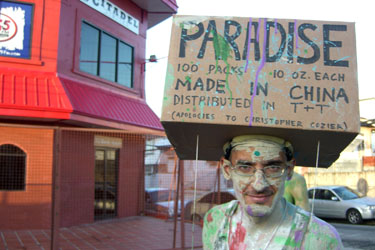
J'Ouvert morning, 23 February, 2009. Photo by Brian Kinzie
Some say that we lost Paradise
Some say that we living Paradise
Some say well if this is Paradise
Good God where the hell is Paradise?
Oh-oh, oh-oh, leh we go, oh-oh, to Paradise....
— 3Canal, “Paradise?”
It is the drizzly Friday morning before Carnival, and I am slumped in my chair, staring at the chaos of my desk, trying to invent a costume for J’Ouvert. This year I am playing with 3Canal. The theme of the band is Paradise?, complete with sardonic question mark, after one of the songs on their new album. Nowadays, most people don’t bother with costumes for J’Ouvert, beyond the obligatory layer of paint or mud. But I like the challenge, in all senses, of a costume. Last year it was devil wings, a bow tie, and a placard. This year, I’m stumped.
I stare at the chaos of my desk. Piles of paper, an empty teacup, my dusty laptop screen. A bowl of paperclips. A small brown cardboard box, not much bigger than a stack of Post-It notes, with plain black text on one side:
FEAR
1 PACK
NET WT. 30 OZS
MADE IN THE USA
It is one of the original hand-stamped boxes from Christopher Cozier’s installation Available At All Leading Stores, shipped down from the gallery in Canada. It has sat on my desk for months, a mordant reminder of my time and place. I summon up iTunes and listen to the 3Canal song.
Buildings filling the skies
And people dying for another to rise
Black gold and crimson tides
Is this Paradise?
I pick up the phone and dial a number. “Chris? It’s Nicholas. What you think of this….”
*
I find a plain cardboard box lying around the house, 16 x 12 x 10 inches--not a cube, but close enough. I spend a couple of days figuring out how I’ll carry it through the streets. Should I strap it to my back? Attach it to a stick so I can hoist it into the air? I don’t want it to get crushed in the intoxicated J’Ouvert throng, and I want to carry it high enough that people can read the words from a distance.
“Put your head inside it and wear it like a mask,” one friend suggests. No, I won’t be able to see where I’m going, and I’ll stifle. Instead I imagine an old-time Fancy Sailor with some papier-mâché extravaganza perched on his head, and two cords dangling in front to help balance the weight.
In the end, the design is simple. I cut an oval into the underside of the box, just slightly smaller than the circumference of my head, and line it with strips of plastic foam. I try it on: the box sits firmly just above my brow, even if I jump around. Next I punch two holes in the underside. I thread in lengths of strong yarn and knot them on the inside. I can grab onto the dangling cords to shift the weight of the box as I move.
Now the text: Chris suggests I blow up a version of his original design, make a colour print, and paste it to the box. I decide on a more low-tech method, hand-lettering the box with a black permanent marker. I haven’t told Chris yet, but I’ve taken liberties with his text. The box now reads:
PARADISE
100 PACKS 10 OZ. EACH
MADE IN CHINA
DISTRIBUTED IN T+T
And in smaller letters:
(APOLOGIES TO CHRISTOPHER COZIER)
*
The history of the Caribbean is a catalogue of trade wars, pillagings, predatory exchanges, bank heists on the scale of whole countries, and bills of sale enforced at gunpoint. Glass beads for gold, blood for sugar, self-respect for tourist dollars, oil for salvation. It sometimes seems there’s nothing we can’t or won’t offer for sale. In what Derek Walcott called “this chain store of islands,” independence only changed the faces of the salesmen, not their tactics.
Cozier conceived Available At All Leading Stores at a particularly anxious moment in recent history. As the wider world worried over the Bush doctrine, Iraq, Guantanamo, and the Axis of Evil, Trinidadians grew obsessed with a spiraling murder rate, garbage-can bombs deposited in downtown Port of Spain, and the latest popular business scheme: kidnappings for ransom. Fear was the hot global commodity, often packaged together with Security in buy-one-get-one-free deals; manufactured in Washington, DC, advertised on CNN and Fox News, traded in capital cities around the world, with special discounts available at the nearest airport metal scanner. Trinidad, always ready to adopt and adapt trendy imports, didn’t lag behind.
Three years later, the market has shifted. Global capitalism as we knew it took a tumble in 2008. American voters replaced Bush 2.0 with a brighter, shinier, and better-designed model. Now the world wants to buy an Obama t-shirt, the one with the new brand name: Hope.
Meanwhile, here in Trinidad, the populace has finally got the invoice for the PNM government’s Potemkin nation project, better known as Vision 2020. The costs are stated in trillions, the fine print seems to be in Cantonese, and the product was broken before it came out of the package. Port of Spain floods and traffic gridlocks in the shadow of half-finished skyscrapers built by imported Chinese labour with imported Chinese materials. They said we were buying Paradise. Well, if this is Paradise, where the hell is Paradise?
*
For three or so hours on J’Ouvert morning, Paradise is an empty space, an absence, in a cardboard box I balance on my head. Watch me, turning into a metaphor for a nation bearing the burden of false advertising and false hopes. If anything and everything is for sale, if art is just another product with varying profit margins, if Cozier can taunt us with the joke of commodified Fear, then I can re-commodify, re-sell, re-brand.
Down Ariapita Avenue and up Carlos Street. Oh-oh, oh-oh, leh we go, oh-oh. Hundreds writhing and rubbing up and gyrating, bareback and torn t-shirts and busted-up sneakers, rum and paint and around our necks the little plastic tags that prove we paid our $200 to play with 3Canal. Oh-oh. Down Tragarete as the sun rises, up Edward and across Gordon, and eventually we reach the Savannah. Oh-oh, oh-oh, leh we go, oh-oh, to Paradise....
But Paradise is heavier than I expected. At half past eight, by Memorial Park, I slip out of the band and stride off with my cardboard box, now spattered with pretty pink and purple paint. It’s early, but the sun is already too hot.
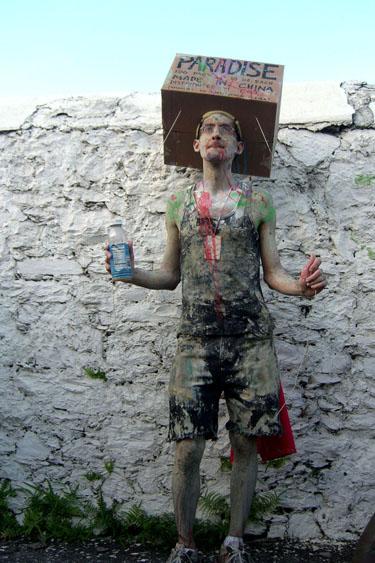
Photo by Brian Kinzie
(Written for the forthcoming e-catalogue of Christopher Cozier’s Available at All Leading Stores, published for the 2009 Trienal Poli/Gráfica de San Juan.)
J'Ouvert morning, 23 February, 2009. Photo by Brian Kinzie
Some say that we lost Paradise
Some say that we living Paradise
Some say well if this is Paradise
Good God where the hell is Paradise?
Oh-oh, oh-oh, leh we go, oh-oh, to Paradise....
— 3Canal, “Paradise?”
It is the drizzly Friday morning before Carnival, and I am slumped in my chair, staring at the chaos of my desk, trying to invent a costume for J’Ouvert. This year I am playing with 3Canal. The theme of the band is Paradise?, complete with sardonic question mark, after one of the songs on their new album. Nowadays, most people don’t bother with costumes for J’Ouvert, beyond the obligatory layer of paint or mud. But I like the challenge, in all senses, of a costume. Last year it was devil wings, a bow tie, and a placard. This year, I’m stumped.
I stare at the chaos of my desk. Piles of paper, an empty teacup, my dusty laptop screen. A bowl of paperclips. A small brown cardboard box, not much bigger than a stack of Post-It notes, with plain black text on one side:
FEAR
1 PACK
NET WT. 30 OZS
MADE IN THE USA
It is one of the original hand-stamped boxes from Christopher Cozier’s installation Available At All Leading Stores, shipped down from the gallery in Canada. It has sat on my desk for months, a mordant reminder of my time and place. I summon up iTunes and listen to the 3Canal song.
Buildings filling the skies
And people dying for another to rise
Black gold and crimson tides
Is this Paradise?
I pick up the phone and dial a number. “Chris? It’s Nicholas. What you think of this….”
*
I find a plain cardboard box lying around the house, 16 x 12 x 10 inches--not a cube, but close enough. I spend a couple of days figuring out how I’ll carry it through the streets. Should I strap it to my back? Attach it to a stick so I can hoist it into the air? I don’t want it to get crushed in the intoxicated J’Ouvert throng, and I want to carry it high enough that people can read the words from a distance.
“Put your head inside it and wear it like a mask,” one friend suggests. No, I won’t be able to see where I’m going, and I’ll stifle. Instead I imagine an old-time Fancy Sailor with some papier-mâché extravaganza perched on his head, and two cords dangling in front to help balance the weight.
In the end, the design is simple. I cut an oval into the underside of the box, just slightly smaller than the circumference of my head, and line it with strips of plastic foam. I try it on: the box sits firmly just above my brow, even if I jump around. Next I punch two holes in the underside. I thread in lengths of strong yarn and knot them on the inside. I can grab onto the dangling cords to shift the weight of the box as I move.
Now the text: Chris suggests I blow up a version of his original design, make a colour print, and paste it to the box. I decide on a more low-tech method, hand-lettering the box with a black permanent marker. I haven’t told Chris yet, but I’ve taken liberties with his text. The box now reads:
PARADISE
100 PACKS 10 OZ. EACH
MADE IN CHINA
DISTRIBUTED IN T+T
And in smaller letters:
(APOLOGIES TO CHRISTOPHER COZIER)
*
The history of the Caribbean is a catalogue of trade wars, pillagings, predatory exchanges, bank heists on the scale of whole countries, and bills of sale enforced at gunpoint. Glass beads for gold, blood for sugar, self-respect for tourist dollars, oil for salvation. It sometimes seems there’s nothing we can’t or won’t offer for sale. In what Derek Walcott called “this chain store of islands,” independence only changed the faces of the salesmen, not their tactics.
Cozier conceived Available At All Leading Stores at a particularly anxious moment in recent history. As the wider world worried over the Bush doctrine, Iraq, Guantanamo, and the Axis of Evil, Trinidadians grew obsessed with a spiraling murder rate, garbage-can bombs deposited in downtown Port of Spain, and the latest popular business scheme: kidnappings for ransom. Fear was the hot global commodity, often packaged together with Security in buy-one-get-one-free deals; manufactured in Washington, DC, advertised on CNN and Fox News, traded in capital cities around the world, with special discounts available at the nearest airport metal scanner. Trinidad, always ready to adopt and adapt trendy imports, didn’t lag behind.
Three years later, the market has shifted. Global capitalism as we knew it took a tumble in 2008. American voters replaced Bush 2.0 with a brighter, shinier, and better-designed model. Now the world wants to buy an Obama t-shirt, the one with the new brand name: Hope.
Meanwhile, here in Trinidad, the populace has finally got the invoice for the PNM government’s Potemkin nation project, better known as Vision 2020. The costs are stated in trillions, the fine print seems to be in Cantonese, and the product was broken before it came out of the package. Port of Spain floods and traffic gridlocks in the shadow of half-finished skyscrapers built by imported Chinese labour with imported Chinese materials. They said we were buying Paradise. Well, if this is Paradise, where the hell is Paradise?
*
For three or so hours on J’Ouvert morning, Paradise is an empty space, an absence, in a cardboard box I balance on my head. Watch me, turning into a metaphor for a nation bearing the burden of false advertising and false hopes. If anything and everything is for sale, if art is just another product with varying profit margins, if Cozier can taunt us with the joke of commodified Fear, then I can re-commodify, re-sell, re-brand.
Down Ariapita Avenue and up Carlos Street. Oh-oh, oh-oh, leh we go, oh-oh. Hundreds writhing and rubbing up and gyrating, bareback and torn t-shirts and busted-up sneakers, rum and paint and around our necks the little plastic tags that prove we paid our $200 to play with 3Canal. Oh-oh. Down Tragarete as the sun rises, up Edward and across Gordon, and eventually we reach the Savannah. Oh-oh, oh-oh, leh we go, oh-oh, to Paradise....
But Paradise is heavier than I expected. At half past eight, by Memorial Park, I slip out of the band and stride off with my cardboard box, now spattered with pretty pink and purple paint. It’s early, but the sun is already too hot.
Photo by Brian Kinzie
Sunday, March 29, 2009
"Everybody wore painted toenails then"
I had read and heard so many malicious accounts of Mrs. Jagan that I was prejudiced in her favour. Although she has suffered much from visiting writers, she received me kindly in her small air-conditioned office. She sat behind a large desk, neatly ordered, on which were photographs of her husband and children. Her bag was on the floor. I thought her far more attractive than her photographs: women who wear spectacles rarely photograph well. A plain cotton frock set off her balanced figure; large hoop ear-rings and red toenails gave her a touch of frivolity which seemed incongruous in that office, the door of which was marked: Hon. Janet Jagan, Minister of Labour, Health and Housing. She looked tired, and her talk was frequently broken by nervous laughter.
-- V.S. Naipaul, The Middle Passage, 1962
Janet ... talked of what I had written about her nearly thirty years before.
"People remembered two details mainly. You wouldn't believe. The first was that I painted my toenails."
I had forgotten that, forgotten the fact, forgotten that I had written it.
"I don't know why that should have caused such interest," she said. "Everybody wore painted toenails then."
"Everybody," Cheddi said.
She said, "I looked at the book just the other day. And the other thing you mentioned that people talked about--I checked that, too--was the book I was reading."
I had forgotten that as well.
"It was Colette. The Vagabond."
That would have made an impression: the boastfulness and shallow sensual vanities of Colette, in a setting so removed: muddy Guyanese rivers, old river steamers. And then, in a distant reach of my mind, the two details together did bring back an impression, rather than an idea, of a trip in the interior with Janet Jagan, when she was minister of health.
She said, "I looked for it among my books the other day. I don't think I have it anymore."
-- V.S. Naipaul, "A Handful of Dust: Cheddi Jagan in Guyana", 1991
(Janet Jagan, 1920-2009)
I had read and heard so many malicious accounts of Mrs. Jagan that I was prejudiced in her favour. Although she has suffered much from visiting writers, she received me kindly in her small air-conditioned office. She sat behind a large desk, neatly ordered, on which were photographs of her husband and children. Her bag was on the floor. I thought her far more attractive than her photographs: women who wear spectacles rarely photograph well. A plain cotton frock set off her balanced figure; large hoop ear-rings and red toenails gave her a touch of frivolity which seemed incongruous in that office, the door of which was marked: Hon. Janet Jagan, Minister of Labour, Health and Housing. She looked tired, and her talk was frequently broken by nervous laughter.
-- V.S. Naipaul, The Middle Passage, 1962
Janet ... talked of what I had written about her nearly thirty years before.
"People remembered two details mainly. You wouldn't believe. The first was that I painted my toenails."
I had forgotten that, forgotten the fact, forgotten that I had written it.
"I don't know why that should have caused such interest," she said. "Everybody wore painted toenails then."
"Everybody," Cheddi said.
She said, "I looked at the book just the other day. And the other thing you mentioned that people talked about--I checked that, too--was the book I was reading."
I had forgotten that as well.
"It was Colette. The Vagabond."
That would have made an impression: the boastfulness and shallow sensual vanities of Colette, in a setting so removed: muddy Guyanese rivers, old river steamers. And then, in a distant reach of my mind, the two details together did bring back an impression, rather than an idea, of a trip in the interior with Janet Jagan, when she was minister of health.
She said, "I looked for it among my books the other day. I don't think I have it anymore."
-- V.S. Naipaul, "A Handful of Dust: Cheddi Jagan in Guyana", 1991
(Janet Jagan, 1920-2009)
Monday, March 16, 2009
Phagwah faces
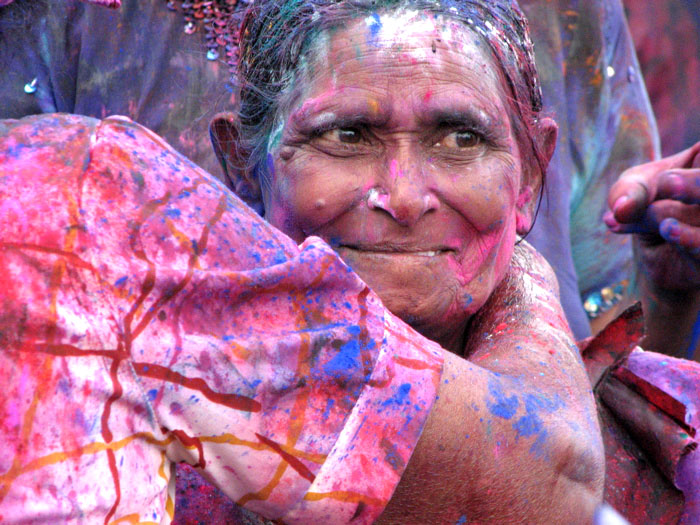
I was drenched with abeer, caked with coloured powder, and stalked by a six-year-old girl with a pichakaree, and I was glad. My photos from yesterday's Phagwah celebrations at Aranguez Savannah are posted here.
I was drenched with abeer, caked with coloured powder, and stalked by a six-year-old girl with a pichakaree, and I was glad. My photos from yesterday's Phagwah celebrations at Aranguez Savannah are posted here.
Sunday, March 15, 2009
A week in the life: 8 to 14 March, 2009
Read: The first half of Marlon James's new novel, The Book of Night Women; lots of random stuff online
Wrote: emails
Listened: to Horace Andy and Bob Marley; and a bit of Ella Fitzgerald
Swam: at Doctor's Cave Beach in Montego Bay
Hiked: up an old donkey trail from Top Jack into the southern foothills of the Blue Mountains
Flew: back home from Jamaica. My brother was co-pilot of the Caribbean Airlines flight--the first time he's flown me since a jaunt to Tobago in a four-seater 'plane nine years ago
Acquired: a copy of the very first issue of Savacou; a bottle of Busha Browne's planter's sauce
Ate: masala dosa at Pushpa's, with Annie; a whole wheat ackee patty (aka a "yattie")
Drank: Twyman Estate peaberry coffee; a mojito
Gave: Georgia her Christmas present, at last
Caught up with: Roxanne and Nicolas, friends visiting from New York
Felt: great affection for Jamaica
Worried: about all the work piled up on my desk, especially CRB business
Regretted: that I haven't been blogging the last couple of months
Plotted: a trip to Suriname and French Guiana next month
Other significant events: 2009 Commonwealth Writers' Prize Caribbean/Canada regional awards announcement ceremony on Wednesday night
Read: The first half of Marlon James's new novel, The Book of Night Women; lots of random stuff online
Wrote: emails
Listened: to Horace Andy and Bob Marley; and a bit of Ella Fitzgerald
Swam: at Doctor's Cave Beach in Montego Bay
Hiked: up an old donkey trail from Top Jack into the southern foothills of the Blue Mountains
Flew: back home from Jamaica. My brother was co-pilot of the Caribbean Airlines flight--the first time he's flown me since a jaunt to Tobago in a four-seater 'plane nine years ago
Acquired: a copy of the very first issue of Savacou; a bottle of Busha Browne's planter's sauce
Ate: masala dosa at Pushpa's, with Annie; a whole wheat ackee patty (aka a "yattie")
Drank: Twyman Estate peaberry coffee; a mojito
Gave: Georgia her Christmas present, at last
Caught up with: Roxanne and Nicolas, friends visiting from New York
Felt: great affection for Jamaica
Worried: about all the work piled up on my desk, especially CRB business
Regretted: that I haven't been blogging the last couple of months
Plotted: a trip to Suriname and French Guiana next month
Other significant events: 2009 Commonwealth Writers' Prize Caribbean/Canada regional awards announcement ceremony on Wednesday night
Subscribe to:
Posts (Atom)