The day they “beautified” HopeThe spot where Tragarete Road meets Dundonald Street and Richmond Street is one of Port of Spain's in-between zones: just a little too far north to be downtown, too far east to be Woodbrook or Newtown — a neighbourhood that doesn't really have a name. One corner of the intersection is occupied by a gas station, another by a car dealership, a third by the old Strand cinema. Because the street grids to the north and south aren't quite aligned, in the intersection itself is a little traffic island, grassed over and roughly triangular. Thousands of people drive or walk past this place on an average weekday.
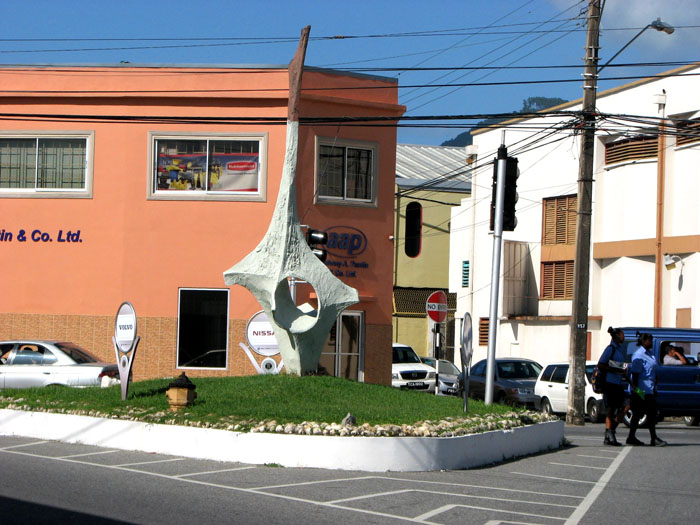
I'd wager not many pause to look at the piece of public art in the middle of the traffic island: a concrete sculpture, perhaps twenty feet tall, abstract in form. From a narrow base it widens into an organic diamond-like shape with an oval void at its centre, womb- or egg-like, then it tapers upwards into a kind of spire. I've often thought of it as a giant needle, its eye framing the view down Richmond Street to the sea. Perhaps thirty years ago, when it was still new, this object stood out in the city's bustle. Nowadays it recedes into the chaos of billboards and traffic.
This is
Spirit of Hope, a work by the late
Patrick Chu Foon (1931-1998), the artist responsible for many of Port of Spain's public sculptures, from the walking
Gandhi (1969) in Kew Place to the
Tribute to the Steelband Movement (1972) in Tamarind Square to
Lord Kitchener (1994) outside the Harvard Club in St. James.
Spirit of Hope was installed in 1971, less than a decade after Independence and a year after the
Black Power Uprising that expressed wide public discontent with Trinidad and Tobago's political and economic leadership. It was not a terribly hopeful point in Trinidad's recent history, to say the least, and I wonder if Chu Foon's sculpture was the manifestation of a genuine optimism or idealism, of an ironic detachment, or of an artist's inward-turning in the face of social breakdown and despair.
I thought of this today when I got a phone call from my friend
Christopher Cozier, who had just driven down Tragarete Road and noticed that someone had painted over the sculpture in a shade of pastel green.
 Georgia Popplewell
 and I decided to see this for ourselves. We drove into town, parked on Fraser Street, and walked round the corner.
Spirit of Hope stood there looking sheepish in its new coat of hospital-wall green. No doubt some civic or corporate entity had decided this isolated object, rather dingy-looking after thirty-eight years in the car exhaust fumes, needed sprucing up. Except the paint ran out before the workmen finished their assignment, or else their ladder wasn't tall enough: the pale green stopped a good four feet below the tip of the spire. It's anyone's guess whether they'll return to finish the job.
I don't know what's worse: this act of vandalisation in the name of philistine "beautification"; or the fact that it was probably the result of considered good intentions (of the kind that pave the proverbial road to perdition); or even the fact that I feel slightly guilty bothering about the whole thing, in the midst of a prolonged nationwide social collapse with far more urgent symptoms. Why am I troubling myself about an obscure piece of public sculpture instead of picketing Whitehall or UDECOTT or the EMA or the office of the Leader of the Opposition or the constituency office of the MP I didn't vote for?
Maybe because this too is a telling symptom. It tells me how unaware we are, as citizens, of the civic spaces we live and work in, and how irresponsibly we behave towards them. It tells me how little respect we have for the work of our artists and thinkers, and how eagerly the powers-that-be package that work in more palatable forms. It tells me we're far too fond of quick, superficial solutions to our problems. Sculpture looking dirty? It would be hard work to research the artist's medium and methods, come up with a serious restoration plan, strip away older layers of unsympathetic paint, and rethink the architecture of that intersection to give the piece context, relevance, poise. Much easier to buy a tin of green paint.
Much easier to pay a few hundred million dollars to drop some big skyscrapers into Port of Spain — look, we have tall buildings, just like Miami! — than to think about the real strengths and flaws of our urban infrastructure, how to preserve the former and fix the latter. (Who cares if downtown still floods if it rains too hard for too long?) Easier to buy a giant blimp to hover over the country like the Eye of Sauron than to understand and address the real social inequalities that drive the crime and murder rate. Easier to erect a prime ministerial palace, it seems, than to build schools and put equipment into hospitals.
So this is what we do with the
Spirit of Hope when it starts to look dingy: give it a cheap coat of paint, don't even bother to finish the job properly, throw up three-four advertising signs around it, and congratulate ourselves on "beautifying" the city — secure in the knowledge that almost nobody will notice.