On being a free man
I’ve not been humiliated by employment, in my own eyes.
— V.S. Naipaul, interviewed on BBC TV in 1994.
Monday, August 16, 2010

Sunday, August 15, 2010
On asceticism
I have never understood asceticism. I have always thought it proceeded from lack of sensuousness, lack of vitality. I’ve never realised that there is a form of asceticism — consisting in simplifying one’s needs and seeking to take a more active role in satisfying them — which is precisely a more developed kind of sensuousness.
— Susan Sontag, Journals, vol. 1, p. 280.
I have never understood asceticism. I have always thought it proceeded from lack of sensuousness, lack of vitality. I’ve never realised that there is a form of asceticism — consisting in simplifying one’s needs and seeking to take a more active role in satisfying them — which is precisely a more developed kind of sensuousness.
— Susan Sontag, Journals, vol. 1, p. 280.
Friday, August 13, 2010
The world’s strange bounty, no. 2
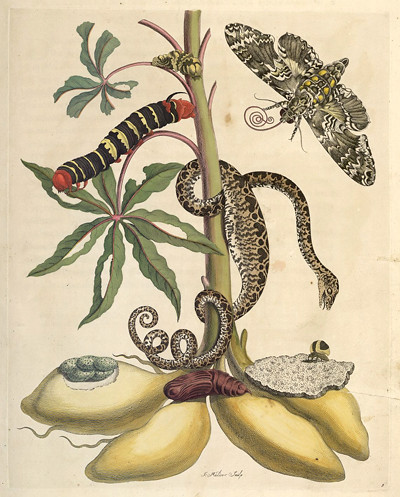
Cassava plant with sphinx moth and tree boa, engraving by Maria Sibylla Merian, from Metamorphosis Insectorum Surinamensium (1705). Courtesy the Göttinger Digitalisierungszentrum.
Cassava plant with sphinx moth and tree boa, engraving by Maria Sibylla Merian, from Metamorphosis Insectorum Surinamensium (1705). Courtesy the Göttinger Digitalisierungszentrum.
Thursday, August 12, 2010
Mental events
Sort of as a result of the interdependence of life and intellectual work, ideas (understood simply as creativity in one’s discipline) rarely occur from pure concentration on the abstracted problems of intellectual work. A sort of decollage, if you will, a thinking by analogy and intuition, the cross-classification of life and work, produces the best ideas. I find this concept easier to grasp in terms of a conjuncture. At any given moment the combination of the books you are reading, the environment you are in, the emotional sensations you are experiencing, the intentions that impel you to think, are utterly unique. And ideas are the mental events that result from such conjunctures.
— From Robert Minto’s reflections on C. Wright Mills’s essay “On Intellectual Craftmanship”.
Sort of as a result of the interdependence of life and intellectual work, ideas (understood simply as creativity in one’s discipline) rarely occur from pure concentration on the abstracted problems of intellectual work. A sort of decollage, if you will, a thinking by analogy and intuition, the cross-classification of life and work, produces the best ideas. I find this concept easier to grasp in terms of a conjuncture. At any given moment the combination of the books you are reading, the environment you are in, the emotional sensations you are experiencing, the intentions that impel you to think, are utterly unique. And ideas are the mental events that result from such conjunctures.
— From Robert Minto’s reflections on C. Wright Mills’s essay “On Intellectual Craftmanship”.
Tuesday, August 10, 2010
“With you giving them the real stuff”
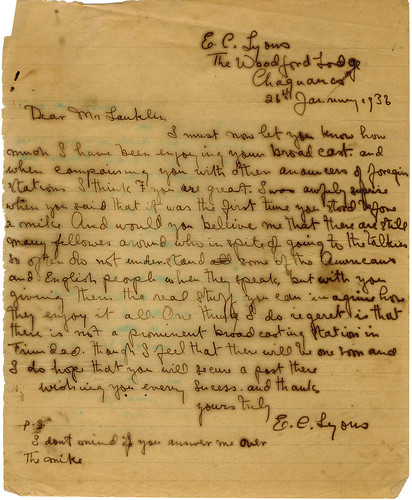
“I must let you know how much I have been enjoying your broadcast.... I was awfully surprised when you said that it was the first time you stood before a mike. And would you believe me that there are still many fellowes [sic] around who in spite of going to the talkies so often do not understand some of the Americans and English people when they speak, but with you giving them the real stuff you can imagine how they enjoy it all.”
This is a fan letter written to my grandfather Ken Laughlin (the letter misspells his name) by E.C. Lyons of Woodford Lodge, Chaguanas, Trinidad, on 26 January, 1937.
My grandfather was a sports journalist for over sixty years. When his weekly programme Ken Laughlin on Sport went off the air in the mid 1990s, it was the longest running radio programme in Trinidad and Tobago, and possibly in the southern Caribbean. In January 1937, he gave the first live radio commentary on a cricket match in the West Indies. It was an intercolonial game, Trinidad vs. Barbados, at the Queen’s Park Oval. He was twenty-three. E.C. Lyons’s letter is one of several congratulating my grandfather on this pioneering broadcast.
(Note that the letter is dated 1936, but this is clearly an error. All the other correspondence relating to this broadcast is dated January or February 1937.)
I’d guess that over the decades he must have got many more letters from listeners in different parts of the Caribbean, but it was this batch, from the very start of his career, that my grandfather decided to save. After he died in 2001, I found them in a box of documents and memorabilia that came into my hands. I’d lost track of them a while back, but found the letters again yesterday (while searching for something else, naturally), and decided to scan a few of them and post them online in my little Flickr family archive. Some of the other fan letters came from San Fernando, Moruga, and Georgetown, British Guiana.
I posted links to the letters on my Facebook page, and got a few comments, including one asking whether the letters were important enough to be archived, and how I planned to preserve them. Well, they’re already in an archive: mine, and scanning and uploading them is one form of preservation. I’m pretty much a pack-rat, and a good couple dozen shelf-feet of documents of all kinds are filed away across several rooms of my house, in different degrees of sortedness — everything from family papers like these letters (or like my other grandfather’s certificates of discharge from the Royal Canadian Steamship Company) to correspondence with friends and colleagues to newspaper clippings on subjects that interest me; also exhibition catalogues, theatre programmes, set lists from jointpop concerts, handwritten notes from Alice Yard meetings, maps of just about every country and city I’ve visited, and masses of material related to the various magazines and other publishing projects I’ve worked on over the years.
This isn’t terribly unusual. I imagine most people working in publishing or in vaguely literary pursuits have similar personal archives. These dozens of feet of boxes and files are obviously important to me, and I hope some of the material I’m so carefully holding on to will turn out to be important to other people in the future. But I also know that my most important archive is one that can’t fit in boxes and manila folders — it’s the online archive anyone can access by typing my name into a search engine.
I can control only some aspects of this. And that’s exactly why I’ve kept this blog going for nearly eight years (and counting), why I have my own website, why I post images to Flickr and share thoughts and links at Twitter. “If it’s not on the web, it doesn’t exist.” Does anyone still remember who specifically first had this insight? Probably not, because it’s so irrefutably apt a summary of how we understand knowledge and our access to it in the Internet age that it might as well be a collective expression of faith. So why wouldn’t I want to use these various media to profess my version of myself, my thoughts, my hopes, anxieties, and dreams?
(A kind of digression: an archive is a record. It is also an assertion — of existence, of significance. It is evidence. It is a model for categorising and understanding the world. It can even be a creative undertaking, a work of art. And while historically the fact of being archived has often been a form of validation — this is important because it is in the archive, that is not and may be discarded and forgotten — cheap online storage available to (theoretically, almost) everybody forces us now to reconsider what an archive is, and again makes it possible for “anyone” to be an archivist, so that personal archives are easy to both assemble and make publicly accessible. The ability to make a public archive has radically expanded.)
In my mind, this is also tied up with bigger ideas of self-determination. Naturally, this is because I’m from a part of the world that historically has been described, portrayed, and defined overwhelmingly through stories told by people from elsewhere: stories about what the Caribbean, the tropics, and small island societies are and should be. I’ve never seen a pirate ship and never worn a grass skirt and, thanks, I do speak fairly good English, even if my accent amuses you. I live in a middle-class suburb of a medium-size city in a largely industrialised country that happens to be a small tropical Caribbean island. Many of my friends are writers, artists, and thinkers working hard to understand themselves as individuals, ourselves as a society, trying to understand what concepts like nation, culture, and history really mean, trying to imagine and build individual and collective futures. Whether or not we acknowledge the lines of succession, many of us are engaged in what the late Lloyd Best repeatedly described as the imperative to comprehend ourselves on and in our own terms. An essential aspect of this process is making sure my — our — ideas, stories, images, and languages are also represented in the global conversation and the global archive of the web. Because if we’re not there, we don’t exist.
It may seem that I’ve strayed a long way from my grandfather’s fan letters. There’s a specific reason I chose E.C. Lyons’s letter to open this post. This is the bit of that letter that I specially like:
... would you believe me that there are still many fellowes around who in spite of going to the talkies so often do not understand some of the Americans and English people when they speak, but with you giving them the real stuff you can imagine how they enjoy it all.
I’m moved by the suggestion that my grandfather’s voice — a Trinidadian voice, speaking Trinidadian English, and expressing a Trinidadian reality — was more meaningful to those listeners in Woodford Lodge seventy-three years ago than the voices of “the Americans and English people” who otherwise occupied the airwaves. It helps me understand the part he played in the still-incomplete epistemological enterprise Best described, and maybe it helps me understand the part I’m playing, or trying to play.
So, yes: these letters are important enough to be archived. They exist physically in my personal archive, and now they exist digitally — epistemologically — if necessary, defiantly — in the archive of the world.
“I must let you know how much I have been enjoying your broadcast.... I was awfully surprised when you said that it was the first time you stood before a mike. And would you believe me that there are still many fellowes [sic] around who in spite of going to the talkies so often do not understand some of the Americans and English people when they speak, but with you giving them the real stuff you can imagine how they enjoy it all.”
This is a fan letter written to my grandfather Ken Laughlin (the letter misspells his name) by E.C. Lyons of Woodford Lodge, Chaguanas, Trinidad, on 26 January, 1937.
My grandfather was a sports journalist for over sixty years. When his weekly programme Ken Laughlin on Sport went off the air in the mid 1990s, it was the longest running radio programme in Trinidad and Tobago, and possibly in the southern Caribbean. In January 1937, he gave the first live radio commentary on a cricket match in the West Indies. It was an intercolonial game, Trinidad vs. Barbados, at the Queen’s Park Oval. He was twenty-three. E.C. Lyons’s letter is one of several congratulating my grandfather on this pioneering broadcast.
(Note that the letter is dated 1936, but this is clearly an error. All the other correspondence relating to this broadcast is dated January or February 1937.)
I’d guess that over the decades he must have got many more letters from listeners in different parts of the Caribbean, but it was this batch, from the very start of his career, that my grandfather decided to save. After he died in 2001, I found them in a box of documents and memorabilia that came into my hands. I’d lost track of them a while back, but found the letters again yesterday (while searching for something else, naturally), and decided to scan a few of them and post them online in my little Flickr family archive. Some of the other fan letters came from San Fernando, Moruga, and Georgetown, British Guiana.
I posted links to the letters on my Facebook page, and got a few comments, including one asking whether the letters were important enough to be archived, and how I planned to preserve them. Well, they’re already in an archive: mine, and scanning and uploading them is one form of preservation. I’m pretty much a pack-rat, and a good couple dozen shelf-feet of documents of all kinds are filed away across several rooms of my house, in different degrees of sortedness — everything from family papers like these letters (or like my other grandfather’s certificates of discharge from the Royal Canadian Steamship Company) to correspondence with friends and colleagues to newspaper clippings on subjects that interest me; also exhibition catalogues, theatre programmes, set lists from jointpop concerts, handwritten notes from Alice Yard meetings, maps of just about every country and city I’ve visited, and masses of material related to the various magazines and other publishing projects I’ve worked on over the years.
This isn’t terribly unusual. I imagine most people working in publishing or in vaguely literary pursuits have similar personal archives. These dozens of feet of boxes and files are obviously important to me, and I hope some of the material I’m so carefully holding on to will turn out to be important to other people in the future. But I also know that my most important archive is one that can’t fit in boxes and manila folders — it’s the online archive anyone can access by typing my name into a search engine.
I can control only some aspects of this. And that’s exactly why I’ve kept this blog going for nearly eight years (and counting), why I have my own website, why I post images to Flickr and share thoughts and links at Twitter. “If it’s not on the web, it doesn’t exist.” Does anyone still remember who specifically first had this insight? Probably not, because it’s so irrefutably apt a summary of how we understand knowledge and our access to it in the Internet age that it might as well be a collective expression of faith. So why wouldn’t I want to use these various media to profess my version of myself, my thoughts, my hopes, anxieties, and dreams?
(A kind of digression: an archive is a record. It is also an assertion — of existence, of significance. It is evidence. It is a model for categorising and understanding the world. It can even be a creative undertaking, a work of art. And while historically the fact of being archived has often been a form of validation — this is important because it is in the archive, that is not and may be discarded and forgotten — cheap online storage available to (theoretically, almost) everybody forces us now to reconsider what an archive is, and again makes it possible for “anyone” to be an archivist, so that personal archives are easy to both assemble and make publicly accessible. The ability to make a public archive has radically expanded.)
In my mind, this is also tied up with bigger ideas of self-determination. Naturally, this is because I’m from a part of the world that historically has been described, portrayed, and defined overwhelmingly through stories told by people from elsewhere: stories about what the Caribbean, the tropics, and small island societies are and should be. I’ve never seen a pirate ship and never worn a grass skirt and, thanks, I do speak fairly good English, even if my accent amuses you. I live in a middle-class suburb of a medium-size city in a largely industrialised country that happens to be a small tropical Caribbean island. Many of my friends are writers, artists, and thinkers working hard to understand themselves as individuals, ourselves as a society, trying to understand what concepts like nation, culture, and history really mean, trying to imagine and build individual and collective futures. Whether or not we acknowledge the lines of succession, many of us are engaged in what the late Lloyd Best repeatedly described as the imperative to comprehend ourselves on and in our own terms. An essential aspect of this process is making sure my — our — ideas, stories, images, and languages are also represented in the global conversation and the global archive of the web. Because if we’re not there, we don’t exist.
It may seem that I’ve strayed a long way from my grandfather’s fan letters. There’s a specific reason I chose E.C. Lyons’s letter to open this post. This is the bit of that letter that I specially like:
... would you believe me that there are still many fellowes around who in spite of going to the talkies so often do not understand some of the Americans and English people when they speak, but with you giving them the real stuff you can imagine how they enjoy it all.
I’m moved by the suggestion that my grandfather’s voice — a Trinidadian voice, speaking Trinidadian English, and expressing a Trinidadian reality — was more meaningful to those listeners in Woodford Lodge seventy-three years ago than the voices of “the Americans and English people” who otherwise occupied the airwaves. It helps me understand the part he played in the still-incomplete epistemological enterprise Best described, and maybe it helps me understand the part I’m playing, or trying to play.
So, yes: these letters are important enough to be archived. They exist physically in my personal archive, and now they exist digitally — epistemologically — if necessary, defiantly — in the archive of the world.
Monday, August 09, 2010
Sunday, August 08, 2010
The world’s strange bounty, no. 1

Glass models of microscopic organisms in the Natural History Museum, Vienna. Photographed in 2007 by Curious Expeditions and posted at Flickr under a Creative Commons license.
Glass models of microscopic organisms in the Natural History Museum, Vienna. Photographed in 2007 by Curious Expeditions and posted at Flickr under a Creative Commons license.
Saturday, August 07, 2010
“The task of a lifetime”
I will do anything to avoid boredom. It is the task of a lifetime. You can never know enough, never work enough, never use the infinitives and participles oddly enough, never impede the movement harshly enough, never leave the mind quickly enough.
— Anne Carson, introduction to “Short Talks”.
I will do anything to avoid boredom. It is the task of a lifetime. You can never know enough, never work enough, never use the infinitives and participles oddly enough, never impede the movement harshly enough, never leave the mind quickly enough.
— Anne Carson, introduction to “Short Talks”.
Friday, August 06, 2010

Thursday, August 05, 2010
“A patriot of your apartment”
When you are a writer, you are a patriot of your apartment. Sometimes your study is more important than the country you are living in.
— Adam Zagajewski, profiled by Arthur Lubow in the Spring 2010 Threepenny Review.
When you are a writer, you are a patriot of your apartment. Sometimes your study is more important than the country you are living in.
— Adam Zagajewski, profiled by Arthur Lubow in the Spring 2010 Threepenny Review.
Tuesday, August 03, 2010
Gadé couman la mizè fini pou nous
An nous dansé Congo,
An nous dansé Pétro,
Papa bon Dié di nan ciel la mizè fini pou nous.
An nous dansé Congo,
An nous dansé Pétro,
Papa bon Dié di nan ciel la mizè fini pou nous.
Thursday, June 10, 2010
Letters to Cicero
Yesterday or maybe the day before, I was reading through my notes from the interview that never was, when I came across a passage, one of Markson’s captured anecdotes. It was in Reader’s Block, and I had marked it with three asterisks — my highest rating, given to those parts I absolutely needed to ask Markson about. “Petrarch sometimes wrote letters to long-dead authors,” Markson writes. “He was also a dedicated hunter of classic manuscripts. Once, after discovering some previously unknown works of Cicero, he wrote Cicero the news.” Reading that again, I thought that maybe art is, in the end, like so many letters to Cicero, notes addressed to the dead, to one’s ancestors and betters, or simply to those one had in mind while working.
— From Paul Maliszewski’s tribute to David Markson in n+1.
Yesterday or maybe the day before, I was reading through my notes from the interview that never was, when I came across a passage, one of Markson’s captured anecdotes. It was in Reader’s Block, and I had marked it with three asterisks — my highest rating, given to those parts I absolutely needed to ask Markson about. “Petrarch sometimes wrote letters to long-dead authors,” Markson writes. “He was also a dedicated hunter of classic manuscripts. Once, after discovering some previously unknown works of Cicero, he wrote Cicero the news.” Reading that again, I thought that maybe art is, in the end, like so many letters to Cicero, notes addressed to the dead, to one’s ancestors and betters, or simply to those one had in mind while working.
— From Paul Maliszewski’s tribute to David Markson in n+1.
Tuesday, June 08, 2010
Love and fear
Jonathan Santlofer: Did you have any training, any art education?
Peter Schjeldahl: No, none.
Jonathan Santlofer: So all of the art history that you bring into the writing you’ve learned or read on your own — things that you bring to it, interpret for a particular piece.
Peter Schjeldahl: Yeah, and this is true, by the way, of Clement Greenberg and Harold Rosenberg, too. The idea of going to school to be an art critic is a very crazy idea. I educated myself in public, which is a very painful way to learn — by writing and then discovering that I don’t know what the fuck I’m talking about. But you remember the lessons vividly. Also, everything I’ve learned about art was (a) because I was actually interested, or (b) I was actually interested in covering my ass because of what I was writing about. Love and fear, the two strongest emotions we have. It all starts with emotion.
— From “Mask of the critic”, an interview published in Guernica in January 2006.
Jonathan Santlofer: Did you have any training, any art education?
Peter Schjeldahl: No, none.
Jonathan Santlofer: So all of the art history that you bring into the writing you’ve learned or read on your own — things that you bring to it, interpret for a particular piece.
Peter Schjeldahl: Yeah, and this is true, by the way, of Clement Greenberg and Harold Rosenberg, too. The idea of going to school to be an art critic is a very crazy idea. I educated myself in public, which is a very painful way to learn — by writing and then discovering that I don’t know what the fuck I’m talking about. But you remember the lessons vividly. Also, everything I’ve learned about art was (a) because I was actually interested, or (b) I was actually interested in covering my ass because of what I was writing about. Love and fear, the two strongest emotions we have. It all starts with emotion.
— From “Mask of the critic”, an interview published in Guernica in January 2006.
Saturday, March 27, 2010
Town on Keate Street
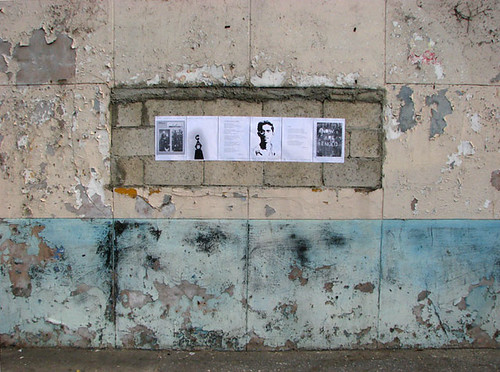
Broadsides from the third issue of Town, posted on Keate Street, opposite Memorial Park, Port of Spain; 27 March, 2010
Broadsides from the third issue of Town, posted on Keate Street, opposite Memorial Park, Port of Spain; 27 March, 2010
Sunday, March 07, 2010
The flight of the cobo
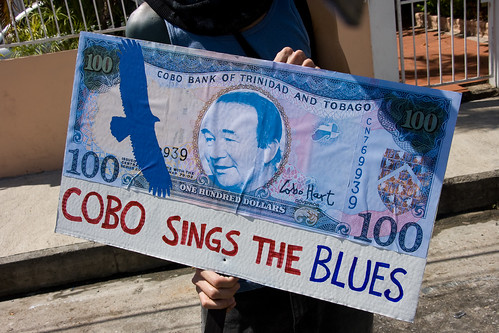
My Carnival Monday placard from the band Cobo Town, proudly carried through the streets of Port of Spain nearly three weeks ago. The face of Calder “Cobo” Hart — head of the powerful state construction agency Udecott, widely suspected of massive financial improprieties and thought by some to be Prime Minister Patrick Manning’s bagman, subject of investigation by the Uff commission of enquiry — replaced the national coat of arms in the middle of a giant $100 bill.
Last night the news broke that Hart, formerly protected by Manning, was forced to resign from Udecott and his positions at other state agencies, and has fled the country with his family. This morning everybody asking how many blue notes this cobo managed to pack in his luggage.
Photo by Georgia Popplewell.
My Carnival Monday placard from the band Cobo Town, proudly carried through the streets of Port of Spain nearly three weeks ago. The face of Calder “Cobo” Hart — head of the powerful state construction agency Udecott, widely suspected of massive financial improprieties and thought by some to be Prime Minister Patrick Manning’s bagman, subject of investigation by the Uff commission of enquiry — replaced the national coat of arms in the middle of a giant $100 bill.
Last night the news broke that Hart, formerly protected by Manning, was forced to resign from Udecott and his positions at other state agencies, and has fled the country with his family. This morning everybody asking how many blue notes this cobo managed to pack in his luggage.
Photo by Georgia Popplewell.
Thursday, March 04, 2010
Overheard
On the pool terrace of the Torarica Hotel, Paramaribo, Suriname; 24 February, 2010:
“Dutch people don’t get a hangover from Parbo. So we can drink as much as we want. It’s because it’s made from rice.”
On the pool terrace of the Torarica Hotel, Paramaribo, Suriname; 24 February, 2010:
“Dutch people don’t get a hangover from Parbo. So we can drink as much as we want. It’s because it’s made from rice.”
Tuesday, March 02, 2010
Town in Paramaribo

Broadsides from the third issue of Town on Kleine Waterstraat in Paramaribo; 26 February, 2010. This issue of Town engages with the Paramaribo SPAN project
Broadsides from the third issue of Town on Kleine Waterstraat in Paramaribo; 26 February, 2010. This issue of Town engages with the Paramaribo SPAN project
Subscribe to:
Posts (Atom)