Gadé couman la mizè fini pou nous
An nous dansé Congo,
An nous dansé Pétro,
Papa bon Dié di nan ciel la mizè fini pou nous.
Tuesday, August 03, 2010

Thursday, June 10, 2010
Letters to Cicero
Yesterday or maybe the day before, I was reading through my notes from the interview that never was, when I came across a passage, one of Markson’s captured anecdotes. It was in Reader’s Block, and I had marked it with three asterisks — my highest rating, given to those parts I absolutely needed to ask Markson about. “Petrarch sometimes wrote letters to long-dead authors,” Markson writes. “He was also a dedicated hunter of classic manuscripts. Once, after discovering some previously unknown works of Cicero, he wrote Cicero the news.” Reading that again, I thought that maybe art is, in the end, like so many letters to Cicero, notes addressed to the dead, to one’s ancestors and betters, or simply to those one had in mind while working.
— From Paul Maliszewski’s tribute to David Markson in n+1.
Yesterday or maybe the day before, I was reading through my notes from the interview that never was, when I came across a passage, one of Markson’s captured anecdotes. It was in Reader’s Block, and I had marked it with three asterisks — my highest rating, given to those parts I absolutely needed to ask Markson about. “Petrarch sometimes wrote letters to long-dead authors,” Markson writes. “He was also a dedicated hunter of classic manuscripts. Once, after discovering some previously unknown works of Cicero, he wrote Cicero the news.” Reading that again, I thought that maybe art is, in the end, like so many letters to Cicero, notes addressed to the dead, to one’s ancestors and betters, or simply to those one had in mind while working.
— From Paul Maliszewski’s tribute to David Markson in n+1.
Tuesday, June 08, 2010
Love and fear
Jonathan Santlofer: Did you have any training, any art education?
Peter Schjeldahl: No, none.
Jonathan Santlofer: So all of the art history that you bring into the writing you’ve learned or read on your own — things that you bring to it, interpret for a particular piece.
Peter Schjeldahl: Yeah, and this is true, by the way, of Clement Greenberg and Harold Rosenberg, too. The idea of going to school to be an art critic is a very crazy idea. I educated myself in public, which is a very painful way to learn — by writing and then discovering that I don’t know what the fuck I’m talking about. But you remember the lessons vividly. Also, everything I’ve learned about art was (a) because I was actually interested, or (b) I was actually interested in covering my ass because of what I was writing about. Love and fear, the two strongest emotions we have. It all starts with emotion.
— From “Mask of the critic”, an interview published in Guernica in January 2006.
Jonathan Santlofer: Did you have any training, any art education?
Peter Schjeldahl: No, none.
Jonathan Santlofer: So all of the art history that you bring into the writing you’ve learned or read on your own — things that you bring to it, interpret for a particular piece.
Peter Schjeldahl: Yeah, and this is true, by the way, of Clement Greenberg and Harold Rosenberg, too. The idea of going to school to be an art critic is a very crazy idea. I educated myself in public, which is a very painful way to learn — by writing and then discovering that I don’t know what the fuck I’m talking about. But you remember the lessons vividly. Also, everything I’ve learned about art was (a) because I was actually interested, or (b) I was actually interested in covering my ass because of what I was writing about. Love and fear, the two strongest emotions we have. It all starts with emotion.
— From “Mask of the critic”, an interview published in Guernica in January 2006.
Saturday, March 27, 2010
Town on Keate Street
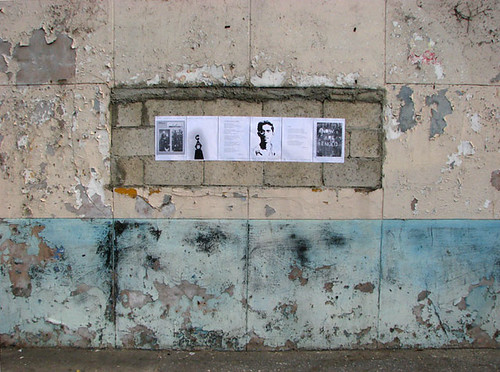
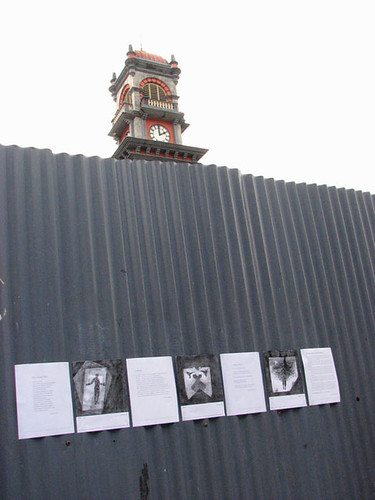
Broadsides from the third issue of Town, posted on Keate Street, opposite Memorial Park, Port of Spain; 27 March, 2010
Broadsides from the third issue of Town, posted on Keate Street, opposite Memorial Park, Port of Spain; 27 March, 2010
Sunday, March 07, 2010
The flight of the cobo
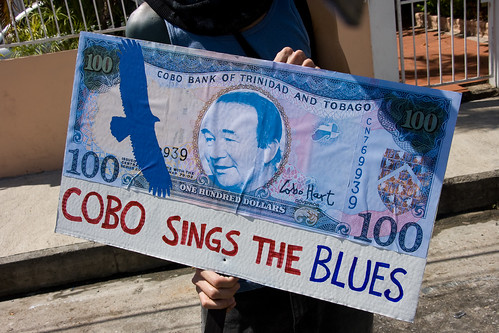
My Carnival Monday placard from the band Cobo Town, proudly carried through the streets of Port of Spain nearly three weeks ago. The face of Calder “Cobo” Hart — head of the powerful state construction agency Udecott, widely suspected of massive financial improprieties and thought by some to be Prime Minister Patrick Manning’s bagman, subject of investigation by the Uff commission of enquiry — replaced the national coat of arms in the middle of a giant $100 bill.
Last night the news broke that Hart, formerly protected by Manning, was forced to resign from Udecott and his positions at other state agencies, and has fled the country with his family. This morning everybody asking how many blue notes this cobo managed to pack in his luggage.
Photo by Georgia Popplewell.
My Carnival Monday placard from the band Cobo Town, proudly carried through the streets of Port of Spain nearly three weeks ago. The face of Calder “Cobo” Hart — head of the powerful state construction agency Udecott, widely suspected of massive financial improprieties and thought by some to be Prime Minister Patrick Manning’s bagman, subject of investigation by the Uff commission of enquiry — replaced the national coat of arms in the middle of a giant $100 bill.
Last night the news broke that Hart, formerly protected by Manning, was forced to resign from Udecott and his positions at other state agencies, and has fled the country with his family. This morning everybody asking how many blue notes this cobo managed to pack in his luggage.
Photo by Georgia Popplewell.
Thursday, March 04, 2010
Overheard
On the pool terrace of the Torarica Hotel, Paramaribo, Suriname; 24 February, 2010:
“Dutch people don’t get a hangover from Parbo. So we can drink as much as we want. It’s because it’s made from rice.”
On the pool terrace of the Torarica Hotel, Paramaribo, Suriname; 24 February, 2010:
“Dutch people don’t get a hangover from Parbo. So we can drink as much as we want. It’s because it’s made from rice.”
Tuesday, March 02, 2010
Town in Paramaribo

Broadsides from the third issue of Town on Kleine Waterstraat in Paramaribo; 26 February, 2010. This issue of Town engages with the Paramaribo SPAN project
Broadsides from the third issue of Town on Kleine Waterstraat in Paramaribo; 26 February, 2010. This issue of Town engages with the Paramaribo SPAN project
Saturday, February 06, 2010
“The rabbit of the Andes and the rabbit of Sar-e-Sang...”
Four poems, published in the February issue of Blackbox Manifold.
Four poems, published in the February issue of Blackbox Manifold.
Monday, February 01, 2010
On not being elsewhere
I came of age in the 1980s, which with adult hindsight I can see was a very pessimistic time for Caribbean people of my parents' generation, but I remember as a schoolchild thinking that people who "went away to live" were specially lucky, even if it was an eventuality I couldn't imagine for myself. Had I gone to university abroad, it's likely I wouldn't have come back to Trinidad, not to live. I still can't decide whether that would have been a better thing.
Having reached my mid-30s, having never lived anywhere else, I'm now fairly certain I'll stay here. But that's something I still think about often — almost every time I travel to the U.S. or Britain, I spend a good chunk of my time trying to imagine an alternative life there. I think that for many Caribbean people of my generation and approximate background — middle class, relatively well-educated — the question of going or staying remains acute.
Sitting here in Diego Martin, west of Port of Spain, it seems to me that in 2010 the literary and intellectual traffic within the Caribbean — and between the region and North America and Europe — is still directed mainly by agents physically located outside the Caribbean itself. Most of our intellectuals and writers are elsewhere. Almost all our books are published elsewhere....
I don't mean to set up a binary opposition between here and there, local and diaspora, us and them, because of course the reality is far more complex. There is conversation and exchange and movement between all these nodes, and they are often fruitful. But aspects of the situation are depressing. For the better part of five centuries the Caribbean was devoted to producing raw materials to enrich already wealthy countries further north. Now sometimes it feels like we're producing cultural raw materials to be turned into books, films, lectures, etc. by intellectual agents in New York or London or Toronto.
I've long admired Scott McLemee's elegant, erudite, and incisive critical writing. We've corresponded, very occasionally and briefly, in the seven-odd years since he reviewed Letters from London, the book of C.L.R. James's early essays I edited. (Among other things, Scott is one of the nicer and more sensible Jamesians around.) I was surprised when he emailed nearly a fortnight ago asking if I'd do an interview for "Intellectual Affairs", his weekly column in Inside Higher Ed. The provocation for the piece was Haiti — specifically, the way the 12 January earthquake was being discussed in the Caribbean, and what this might suggest about cultural and historical attitudes, as well as the current state of Caribbean intellectual life. Hardly narrow matters, and inevitably messy.
Over the course of a few days, Scott emailed me two or three difficult questions, which I answered with deliberate speed. I typed quickly, didn't revise or polish, didn't specially try for nuance. The result — gently tidied up by Scott, and published last Wednesday — is here.
Our conversation begins and ends with Haiti, but digresses down some of the anxious paths my thoughts seem to trace these days. Re-reading it afterwards, I wondered if I should have tried to be less pessimistic, more tactful. But I think it accurately captures something of my state of mind this last year or two. Something of my mental grappling with — for? — context and relevance.
I came of age in the 1980s, which with adult hindsight I can see was a very pessimistic time for Caribbean people of my parents' generation, but I remember as a schoolchild thinking that people who "went away to live" were specially lucky, even if it was an eventuality I couldn't imagine for myself. Had I gone to university abroad, it's likely I wouldn't have come back to Trinidad, not to live. I still can't decide whether that would have been a better thing.
Having reached my mid-30s, having never lived anywhere else, I'm now fairly certain I'll stay here. But that's something I still think about often — almost every time I travel to the U.S. or Britain, I spend a good chunk of my time trying to imagine an alternative life there. I think that for many Caribbean people of my generation and approximate background — middle class, relatively well-educated — the question of going or staying remains acute.
Sitting here in Diego Martin, west of Port of Spain, it seems to me that in 2010 the literary and intellectual traffic within the Caribbean — and between the region and North America and Europe — is still directed mainly by agents physically located outside the Caribbean itself. Most of our intellectuals and writers are elsewhere. Almost all our books are published elsewhere....
I don't mean to set up a binary opposition between here and there, local and diaspora, us and them, because of course the reality is far more complex. There is conversation and exchange and movement between all these nodes, and they are often fruitful. But aspects of the situation are depressing. For the better part of five centuries the Caribbean was devoted to producing raw materials to enrich already wealthy countries further north. Now sometimes it feels like we're producing cultural raw materials to be turned into books, films, lectures, etc. by intellectual agents in New York or London or Toronto.
I've long admired Scott McLemee's elegant, erudite, and incisive critical writing. We've corresponded, very occasionally and briefly, in the seven-odd years since he reviewed Letters from London, the book of C.L.R. James's early essays I edited. (Among other things, Scott is one of the nicer and more sensible Jamesians around.) I was surprised when he emailed nearly a fortnight ago asking if I'd do an interview for "Intellectual Affairs", his weekly column in Inside Higher Ed. The provocation for the piece was Haiti — specifically, the way the 12 January earthquake was being discussed in the Caribbean, and what this might suggest about cultural and historical attitudes, as well as the current state of Caribbean intellectual life. Hardly narrow matters, and inevitably messy.
Over the course of a few days, Scott emailed me two or three difficult questions, which I answered with deliberate speed. I typed quickly, didn't revise or polish, didn't specially try for nuance. The result — gently tidied up by Scott, and published last Wednesday — is here.
Our conversation begins and ends with Haiti, but digresses down some of the anxious paths my thoughts seem to trace these days. Re-reading it afterwards, I wondered if I should have tried to be less pessimistic, more tactful. But I think it accurately captures something of my state of mind this last year or two. Something of my mental grappling with — for? — context and relevance.
Thursday, January 28, 2010
A brief personal note
Even now, almost eighteen years later, I can’t say exactly why: but it was “Seymour: An Introduction”, read when I was sixteen years old, that first made me want to write.
I think the appropriate word is “goddam”.
Even now, almost eighteen years later, I can’t say exactly why: but it was “Seymour: An Introduction”, read when I was sixteen years old, that first made me want to write.
I think the appropriate word is “goddam”.
Monday, December 21, 2009
“Spaciousness, intimacy, and silence”
Define happiness, someone asked me recently. Absorption, I said instantly (it was an e-mail interview), and anything that gives me an inner life and a sense of spaciousness, intimacy and silence. The world is much better for many of us now than it was 10 years ago, and I never could have dreamed so many of us would have so many kinds of diversion, excitement and information at our fingertips.
But information cannot teach the use of information. And diversion doesn’t teach us concentration. Imagine a seven-hour-long heart-to-heart with someone who’s been saving up all her life for what she’s about to whisper in your ear. The medium that has been dying the whole century may be one way we can rebel against the hidden dictatorship of Right Now.
— Pico Iyer on “the tyranny of the moment” in the Los Angeles Times.
Define happiness, someone asked me recently. Absorption, I said instantly (it was an e-mail interview), and anything that gives me an inner life and a sense of spaciousness, intimacy and silence. The world is much better for many of us now than it was 10 years ago, and I never could have dreamed so many of us would have so many kinds of diversion, excitement and information at our fingertips.
But information cannot teach the use of information. And diversion doesn’t teach us concentration. Imagine a seven-hour-long heart-to-heart with someone who’s been saving up all her life for what she’s about to whisper in your ear. The medium that has been dying the whole century may be one way we can rebel against the hidden dictatorship of Right Now.
— Pico Iyer on “the tyranny of the moment” in the Los Angeles Times.
Friday, November 13, 2009
Slipping down the slope
Since the Media Association of Trinidad and Tobago doesn't currently have a website, I've decided to post this statement, just received by email from the MATT executive:
It was with shock and dismay that the media association learned of the recommendations of the Privileges Committee of the House of Representatives with regard to Mr Andre Bagoo of the Newsday newspaper.
On finding Mr Bagoo guilty of an offence, the committee recommended not only that the newspaper publish an apology, but also that Mr Bagoo be banned from the media gallery of Parliament until the end of the session.
Matt considers this an unjustifiably harsh and highly unusual punishment.
Mr Bagoo had been accused by Information Minister Neil Parsanlal of committing a contempt of Parliament by publishing the proceedings of the Privileges Committee in another matter before those proceedings had been reported to the House.
The association admits that this publication by Newsday was indeed in breach of the Standing Orders of Parliament.
However, in previous cases involving breaches of privilege--including the case prematurely reported by Mr Bagoo, which involved Udecott--once the accused party apologises for the offence, he or she is almost invariably let off and no further action taken. It should be noted that the editor in chief of Newsday, Ms Therese Mills, appeared before the committee and apologised for breaching the Standing Orders.
In addition, in a minority report, three members of the committee disagreed with the recommendations and argued that banning a reporter contravened the constitutionally enshrined freedom of the press. They asked that members of the House reject either the entire report or that recommendation.
Matt endorses this call, and now awaits with apprehension the committee’s findings in the case of two other journalists also sent to the Privileges Committee.
In light of the recommendations in the case of Mr Bagoo, Matt notes with grave concern that a pattern may be emerging of attempted intimidation, by way of the Privileges Committee, of journalists whose reporting may have embarrassed or offended the Government.
Since the Media Association of Trinidad and Tobago doesn't currently have a website, I've decided to post this statement, just received by email from the MATT executive:
It was with shock and dismay that the media association learned of the recommendations of the Privileges Committee of the House of Representatives with regard to Mr Andre Bagoo of the Newsday newspaper.
On finding Mr Bagoo guilty of an offence, the committee recommended not only that the newspaper publish an apology, but also that Mr Bagoo be banned from the media gallery of Parliament until the end of the session.
Matt considers this an unjustifiably harsh and highly unusual punishment.
Mr Bagoo had been accused by Information Minister Neil Parsanlal of committing a contempt of Parliament by publishing the proceedings of the Privileges Committee in another matter before those proceedings had been reported to the House.
The association admits that this publication by Newsday was indeed in breach of the Standing Orders of Parliament.
However, in previous cases involving breaches of privilege--including the case prematurely reported by Mr Bagoo, which involved Udecott--once the accused party apologises for the offence, he or she is almost invariably let off and no further action taken. It should be noted that the editor in chief of Newsday, Ms Therese Mills, appeared before the committee and apologised for breaching the Standing Orders.
In addition, in a minority report, three members of the committee disagreed with the recommendations and argued that banning a reporter contravened the constitutionally enshrined freedom of the press. They asked that members of the House reject either the entire report or that recommendation.
Matt endorses this call, and now awaits with apprehension the committee’s findings in the case of two other journalists also sent to the Privileges Committee.
In light of the recommendations in the case of Mr Bagoo, Matt notes with grave concern that a pattern may be emerging of attempted intimidation, by way of the Privileges Committee, of journalists whose reporting may have embarrassed or offended the Government.
Tuesday, November 10, 2009
Dear Aunt Jobiska
Off the roots. Come on, join
Perhaps—I gripped the chair more tighdy
African temper in amour
For his Aunt Jobiska said, “No harm”
They sailed away in a Sieve, they did
Return hot joy time!
No brakes in amour
— A found poem, if you will: my favourite spam email subject lines from the past week. Apologies to Edward Lear clearly required.
Off the roots. Come on, join
Perhaps—I gripped the chair more tighdy
African temper in amour
For his Aunt Jobiska said, “No harm”
They sailed away in a Sieve, they did
Return hot joy time!
No brakes in amour
— A found poem, if you will: my favourite spam email subject lines from the past week. Apologies to Edward Lear clearly required.
Sunday, October 25, 2009
“It’s quite practical”
I have no use for the idea that what needs to be written will get written. I am fully aware that if practical circumstances allowed, I’d write more, and of better quality, that now probably won’t get written. I don’t mean this to sound mystical. It’s quite practical really. I think many good writers never make it and much good writing is lost or undone.
— My friend, collaborator, and co-editor Vahni Capildeo, interviewed today at the newish arts blog PLEASURE (first of a series of interviews with Trinidadian artists called “This/discourse/has/no/start(middle)nd”).
I have no use for the idea that what needs to be written will get written. I am fully aware that if practical circumstances allowed, I’d write more, and of better quality, that now probably won’t get written. I don’t mean this to sound mystical. It’s quite practical really. I think many good writers never make it and much good writing is lost or undone.
— My friend, collaborator, and co-editor Vahni Capildeo, interviewed today at the newish arts blog PLEASURE (first of a series of interviews with Trinidadian artists called “This/discourse/has/no/start(middle)nd”).
Wednesday, October 21, 2009
The day they “beautified” Hope
The spot where Tragarete Road meets Dundonald Street and Richmond Street is one of Port of Spain's in-between zones: just a little too far north to be downtown, too far east to be Woodbrook or Newtown — a neighbourhood that doesn't really have a name. One corner of the intersection is occupied by a gas station, another by a car dealership, a third by the old Strand cinema. Because the street grids to the north and south aren't quite aligned, in the intersection itself is a little traffic island, grassed over and roughly triangular. Thousands of people drive or walk past this place on an average weekday.
I'd wager not many pause to look at the piece of public art in the middle of the traffic island: a concrete sculpture, perhaps twenty feet tall, abstract in form. From a narrow base it widens into an organic diamond-like shape with an oval void at its centre, womb- or egg-like, then it tapers upwards into a kind of spire. I've often thought of it as a giant needle, its eye framing the view down Richmond Street to the sea. Perhaps thirty years ago, when it was still new, this object stood out in the city's bustle. Nowadays it recedes into the chaos of billboards and traffic.
This is Spirit of Hope, a work by the late Patrick Chu Foon (1931-1998), the artist responsible for many of Port of Spain's public sculptures, from the walking Gandhi (1969) in Kew Place to the Tribute to the Steelband Movement (1972) in Tamarind Square to Lord Kitchener (1994) outside the Harvard Club in St. James.
Spirit of Hope was installed in 1971, less than a decade after Independence and a year after the Black Power Uprising that expressed wide public discontent with Trinidad and Tobago's political and economic leadership. It was not a terribly hopeful point in Trinidad's recent history, to say the least, and I wonder if Chu Foon's sculpture was the manifestation of a genuine optimism or idealism, of an ironic detachment, or of an artist's inward-turning in the face of social breakdown and despair.
I thought of this today when I got a phone call from my friend Christopher Cozier, who had just driven down Tragarete Road and noticed that someone had painted over the sculpture in a shade of pastel green.
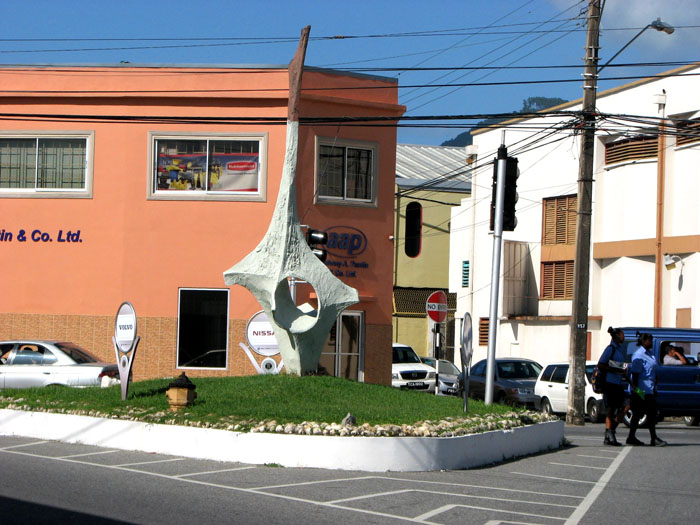
Georgia Popplewell and I decided to see this for ourselves. We drove into town, parked on Fraser Street, and walked round the corner. Spirit of Hope stood there looking sheepish in its new coat of hospital-wall green. No doubt some civic or corporate entity had decided this isolated object, rather dingy-looking after thirty-eight years in the car exhaust fumes, needed sprucing up. Except the paint ran out before the workmen finished their assignment, or else their ladder wasn't tall enough: the pale green stopped a good four feet below the tip of the spire. It's anyone's guess whether they'll return to finish the job.
I don't know what's worse: this act of vandalisation in the name of philistine "beautification"; or the fact that it was probably the result of considered good intentions (of the kind that pave the proverbial road to perdition); or even the fact that I feel slightly guilty bothering about the whole thing, in the midst of a prolonged nationwide social collapse with far more urgent symptoms. Why am I troubling myself about an obscure piece of public sculpture instead of picketing Whitehall or UDECOTT or the EMA or the office of the Leader of the Opposition or the constituency office of the MP I didn't vote for?
Maybe because this too is a telling symptom. It tells me how unaware we are, as citizens, of the civic spaces we live and work in, and how irresponsibly we behave towards them. It tells me how little respect we have for the work of our artists and thinkers, and how eagerly the powers-that-be package that work in more palatable forms. It tells me we're far too fond of quick, superficial solutions to our problems. Sculpture looking dirty? It would be hard work to research the artist's medium and methods, come up with a serious restoration plan, strip away older layers of unsympathetic paint, and rethink the architecture of that intersection to give the piece context, relevance, poise. Much easier to buy a tin of green paint.
Much easier to pay a few hundred million dollars to drop some big skyscrapers into Port of Spain — look, we have tall buildings, just like Miami! — than to think about the real strengths and flaws of our urban infrastructure, how to preserve the former and fix the latter. (Who cares if downtown still floods if it rains too hard for too long?) Easier to buy a giant blimp to hover over the country like the Eye of Sauron than to understand and address the real social inequalities that drive the crime and murder rate. Easier to erect a prime ministerial palace, it seems, than to build schools and put equipment into hospitals.
So this is what we do with the Spirit of Hope when it starts to look dingy: give it a cheap coat of paint, don't even bother to finish the job properly, throw up three-four advertising signs around it, and congratulate ourselves on "beautifying" the city — secure in the knowledge that almost nobody will notice.
The spot where Tragarete Road meets Dundonald Street and Richmond Street is one of Port of Spain's in-between zones: just a little too far north to be downtown, too far east to be Woodbrook or Newtown — a neighbourhood that doesn't really have a name. One corner of the intersection is occupied by a gas station, another by a car dealership, a third by the old Strand cinema. Because the street grids to the north and south aren't quite aligned, in the intersection itself is a little traffic island, grassed over and roughly triangular. Thousands of people drive or walk past this place on an average weekday.
I'd wager not many pause to look at the piece of public art in the middle of the traffic island: a concrete sculpture, perhaps twenty feet tall, abstract in form. From a narrow base it widens into an organic diamond-like shape with an oval void at its centre, womb- or egg-like, then it tapers upwards into a kind of spire. I've often thought of it as a giant needle, its eye framing the view down Richmond Street to the sea. Perhaps thirty years ago, when it was still new, this object stood out in the city's bustle. Nowadays it recedes into the chaos of billboards and traffic.
This is Spirit of Hope, a work by the late Patrick Chu Foon (1931-1998), the artist responsible for many of Port of Spain's public sculptures, from the walking Gandhi (1969) in Kew Place to the Tribute to the Steelband Movement (1972) in Tamarind Square to Lord Kitchener (1994) outside the Harvard Club in St. James.
Spirit of Hope was installed in 1971, less than a decade after Independence and a year after the Black Power Uprising that expressed wide public discontent with Trinidad and Tobago's political and economic leadership. It was not a terribly hopeful point in Trinidad's recent history, to say the least, and I wonder if Chu Foon's sculpture was the manifestation of a genuine optimism or idealism, of an ironic detachment, or of an artist's inward-turning in the face of social breakdown and despair.
I thought of this today when I got a phone call from my friend Christopher Cozier, who had just driven down Tragarete Road and noticed that someone had painted over the sculpture in a shade of pastel green.
Georgia Popplewell and I decided to see this for ourselves. We drove into town, parked on Fraser Street, and walked round the corner. Spirit of Hope stood there looking sheepish in its new coat of hospital-wall green. No doubt some civic or corporate entity had decided this isolated object, rather dingy-looking after thirty-eight years in the car exhaust fumes, needed sprucing up. Except the paint ran out before the workmen finished their assignment, or else their ladder wasn't tall enough: the pale green stopped a good four feet below the tip of the spire. It's anyone's guess whether they'll return to finish the job.
I don't know what's worse: this act of vandalisation in the name of philistine "beautification"; or the fact that it was probably the result of considered good intentions (of the kind that pave the proverbial road to perdition); or even the fact that I feel slightly guilty bothering about the whole thing, in the midst of a prolonged nationwide social collapse with far more urgent symptoms. Why am I troubling myself about an obscure piece of public sculpture instead of picketing Whitehall or UDECOTT or the EMA or the office of the Leader of the Opposition or the constituency office of the MP I didn't vote for?
Maybe because this too is a telling symptom. It tells me how unaware we are, as citizens, of the civic spaces we live and work in, and how irresponsibly we behave towards them. It tells me how little respect we have for the work of our artists and thinkers, and how eagerly the powers-that-be package that work in more palatable forms. It tells me we're far too fond of quick, superficial solutions to our problems. Sculpture looking dirty? It would be hard work to research the artist's medium and methods, come up with a serious restoration plan, strip away older layers of unsympathetic paint, and rethink the architecture of that intersection to give the piece context, relevance, poise. Much easier to buy a tin of green paint.
Much easier to pay a few hundred million dollars to drop some big skyscrapers into Port of Spain — look, we have tall buildings, just like Miami! — than to think about the real strengths and flaws of our urban infrastructure, how to preserve the former and fix the latter. (Who cares if downtown still floods if it rains too hard for too long?) Easier to buy a giant blimp to hover over the country like the Eye of Sauron than to understand and address the real social inequalities that drive the crime and murder rate. Easier to erect a prime ministerial palace, it seems, than to build schools and put equipment into hospitals.
So this is what we do with the Spirit of Hope when it starts to look dingy: give it a cheap coat of paint, don't even bother to finish the job properly, throw up three-four advertising signs around it, and congratulate ourselves on "beautifying" the city — secure in the knowledge that almost nobody will notice.
Saturday, October 17, 2009
Town on lower George Street
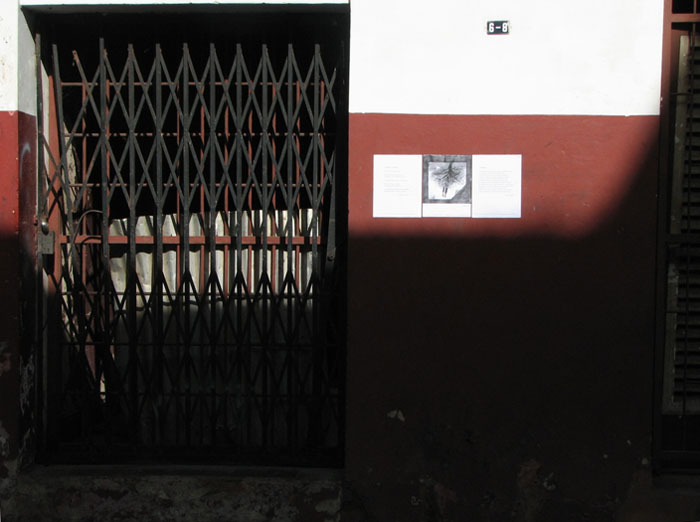
Broadsides from the first issue of Town, posted on the old Angostura Building, lower George Street, Port of Spain; 17 October, 2009
Broadsides from the first issue of Town, posted on the old Angostura Building, lower George Street, Port of Spain; 17 October, 2009
Friday, October 16, 2009
No license, no registration
Yesterday, Wesley Gibbings, president of the Association of Caribbean Media Workers (ACM), sent the following message to media associations around the region:
This is to advise of the imminent introduction of a Model Professional Services Bill to Caricom member states which calls for, among other things, the registration and licensing of media workers.
The bill is meant to 'regularise' and harmonise standards among professionals in a wide range of categories under the ambit of the CSME.
The subject was raised at a CSME workshop in St Lucia on October 12 by Caricom officials.
I have already advised that this matter is not subject to negotiation. It is a well-established fact that the licensing of journalists constitutes an outright threat to freedom of the press and other rights. There is also a growing body of international judicial precedents which determines its unlawful nature.
The ACM is moving quickly to nip this in the bud. We are inviting a senior Caricom official to discuss this matter with us at the forthcoming conference and fifth biennial general meeting in Grenada on December 10-12. Hopefully, the outcome will be a very clear message to have this withdrawn as a proposal to Caricom member states.
This is dangerous territory and I am urging all of us to use the tools at our disposal to publicise this issue and to act decisively to ensure the model Bill, especially as it relates to media workers, does not reach anywhere near our parliaments.
We will be mobilising international support for the campaign.
Georgia Popplewell links to a copy of the draft bill here. She urges her readers to publicise this issue, and I want to do the same. (Georgia also notes that the Media Association of Trinidad and Tobago, which forwarded Gibbings's message to its members last night via Facebook, does not have a "proper, public-facing web site" — their blog hasn't been updated since May 2007 — which, for a group of media professionals in AD 2009, is almost unbelievable. I want to add that although the ACM does have an informative website, they are yet to post anything about the Model Professionals Bill there.)
I also want to urge interested readers — and I hope you are all interested, not to mention alarmed at the possibility of regional legislation for registering journalists — to read the draft bill. It is meant to apply to a wide range of professions, but it takes no account of the circumstances and principles that make, say, medicine or engineering different to journalism. The draft bill, which is meant to be adopted by all Caricom states and leaves various blanks to be filled by respective governments, if applied to journalists and media workers, would:
= set up a professional council with some members chosen by media workers and some appointed by the government — the proportions of one to the other are left to individual governments;
= require all media workers to apply to that council for registration;
= further require all media workers to apply and pay for an annual license to practise their profession, with the fee to be determined by individual governments;
= require media workers to "display such License in a place in the facility where he operates, that is normally accessible to the public";
= forbid unlicensed persons from practising journalism, on pain of "summary conviction to a fine of [ ] or to imprisonment for [#] years". (Imagine the glee with which the Trinidad and Tobago Cabinet would fill in those blanks.)
With a few simple manipulations, this bill could essentially give Caricom governments the power to determine who can and cannot practise journalism. And it leaves citizen journalists — who the Caribbean mainstream media still don't quite understand or respect — in limbo. Would I be legally required to apply for registration and a license to continue writing on this blog? I don't "cover" "news" per se, but I have reported and commented on current events in the past, and insist on the right to do so in the future. Does that make me a journalist under the terms of the bill?
I don't have court clothes, and I don't intend to buy any. Please spread the word about this misguided piece of possible legislation and let's make it clear to Caricom that, as Gibbings writes, "this matter is not subject to negotiation."
Yesterday, Wesley Gibbings, president of the Association of Caribbean Media Workers (ACM), sent the following message to media associations around the region:
This is to advise of the imminent introduction of a Model Professional Services Bill to Caricom member states which calls for, among other things, the registration and licensing of media workers.
The bill is meant to 'regularise' and harmonise standards among professionals in a wide range of categories under the ambit of the CSME.
The subject was raised at a CSME workshop in St Lucia on October 12 by Caricom officials.
I have already advised that this matter is not subject to negotiation. It is a well-established fact that the licensing of journalists constitutes an outright threat to freedom of the press and other rights. There is also a growing body of international judicial precedents which determines its unlawful nature.
The ACM is moving quickly to nip this in the bud. We are inviting a senior Caricom official to discuss this matter with us at the forthcoming conference and fifth biennial general meeting in Grenada on December 10-12. Hopefully, the outcome will be a very clear message to have this withdrawn as a proposal to Caricom member states.
This is dangerous territory and I am urging all of us to use the tools at our disposal to publicise this issue and to act decisively to ensure the model Bill, especially as it relates to media workers, does not reach anywhere near our parliaments.
We will be mobilising international support for the campaign.
Georgia Popplewell links to a copy of the draft bill here. She urges her readers to publicise this issue, and I want to do the same. (Georgia also notes that the Media Association of Trinidad and Tobago, which forwarded Gibbings's message to its members last night via Facebook, does not have a "proper, public-facing web site" — their blog hasn't been updated since May 2007 — which, for a group of media professionals in AD 2009, is almost unbelievable. I want to add that although the ACM does have an informative website, they are yet to post anything about the Model Professionals Bill there.)
I also want to urge interested readers — and I hope you are all interested, not to mention alarmed at the possibility of regional legislation for registering journalists — to read the draft bill. It is meant to apply to a wide range of professions, but it takes no account of the circumstances and principles that make, say, medicine or engineering different to journalism. The draft bill, which is meant to be adopted by all Caricom states and leaves various blanks to be filled by respective governments, if applied to journalists and media workers, would:
= set up a professional council with some members chosen by media workers and some appointed by the government — the proportions of one to the other are left to individual governments;
= require all media workers to apply to that council for registration;
= further require all media workers to apply and pay for an annual license to practise their profession, with the fee to be determined by individual governments;
= require media workers to "display such License in a place in the facility where he operates, that is normally accessible to the public";
= forbid unlicensed persons from practising journalism, on pain of "summary conviction to a fine of [ ] or to imprisonment for [#] years". (Imagine the glee with which the Trinidad and Tobago Cabinet would fill in those blanks.)
With a few simple manipulations, this bill could essentially give Caricom governments the power to determine who can and cannot practise journalism. And it leaves citizen journalists — who the Caribbean mainstream media still don't quite understand or respect — in limbo. Would I be legally required to apply for registration and a license to continue writing on this blog? I don't "cover" "news" per se, but I have reported and commented on current events in the past, and insist on the right to do so in the future. Does that make me a journalist under the terms of the bill?
I don't have court clothes, and I don't intend to buy any. Please spread the word about this misguided piece of possible legislation and let's make it clear to Caricom that, as Gibbings writes, "this matter is not subject to negotiation."
Tuesday, October 13, 2009
Urbi et orbi
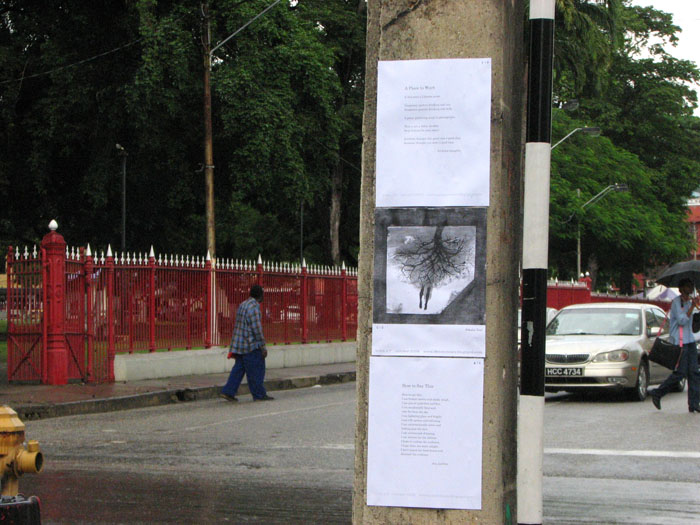
The corner of Abercromby Street and Hart Street, Port of Spain
A new project, but one I’ve been turning over in my head for some time: Town, a modest literary magazine, publishing poems, very short prose, and images in broadside editions, and also (of course) online.
This is partly (I will admit) a response to my continued anxiety and uncertainty about the future of the CRB; partly a way to experiment with different ways of no-budget, non-profit literary publishing; partly an opportunity to make things, attractive physical objects—in this case, simple 8½ x 11-inch broadsides run off on ordinary office equipment (huge thanks to my friend Sean Leonard for his help with this). We’ve printed a few dozen copies of each broadside, and begun posting them around Port of Spain on walls, fences, lampposts, and elsewhere.
I asked my friends Anu Lakhan and Vahni Capildeo, brilliant writers both, to be my co-editors. We agreed to include one poem by each of us in the first issue—if we’re going to ask other writers to let us stick their work up on public walls, we thought, we should be willing to do the same with our own. We also included a wry and very short fable by Kelvin Christopher James, a Trinidadian writer based in New York (whose work I’d previously published in the CRB), and three beautiful, haunting images by Nikolai Noel (1, 2, 3), excerpted from a larger work in progress.
Town launched last week: Anu and I traipsed round Port of Spain on Friday with a sheaf of broadsides and a roll of masking tape. We hope people will be surprised, perhaps delighted, perhaps confused by these fragments of poetry and art scattered through the city’s urban topography. We hope people will like them enough to steal the broadsides and take them home (by Saturday night one was already missing from the hoarding outside QRC). Those who don’t live or work in Port of Spain can read the full contents of the magazine at our website, and if you like what you find there, you can download PDFs of the broadsides, print them from your desktop, and post them wherever you please.
More about the hows and whys of Town here. Find out how to contribute here. See images of the broadsides posted around Port of Spain and elsewhere here. The first issue is all-Trinidadian, but for future issues there is no geographical restriction on contributing writers and artists: we simply want to publish good work, whether its effect is to surprise, to delight, or to confuse.
And here is my own contribution to the first issue of Town: a poem called “A Place to Start”.
Outside QRC, Maraval Road, Port of Spain
The corner of Abercromby Street and Hart Street, Port of Spain
A new project, but one I’ve been turning over in my head for some time: Town, a modest literary magazine, publishing poems, very short prose, and images in broadside editions, and also (of course) online.
This is partly (I will admit) a response to my continued anxiety and uncertainty about the future of the CRB; partly a way to experiment with different ways of no-budget, non-profit literary publishing; partly an opportunity to make things, attractive physical objects—in this case, simple 8½ x 11-inch broadsides run off on ordinary office equipment (huge thanks to my friend Sean Leonard for his help with this). We’ve printed a few dozen copies of each broadside, and begun posting them around Port of Spain on walls, fences, lampposts, and elsewhere.
I asked my friends Anu Lakhan and Vahni Capildeo, brilliant writers both, to be my co-editors. We agreed to include one poem by each of us in the first issue—if we’re going to ask other writers to let us stick their work up on public walls, we thought, we should be willing to do the same with our own. We also included a wry and very short fable by Kelvin Christopher James, a Trinidadian writer based in New York (whose work I’d previously published in the CRB), and three beautiful, haunting images by Nikolai Noel (1, 2, 3), excerpted from a larger work in progress.
Town launched last week: Anu and I traipsed round Port of Spain on Friday with a sheaf of broadsides and a roll of masking tape. We hope people will be surprised, perhaps delighted, perhaps confused by these fragments of poetry and art scattered through the city’s urban topography. We hope people will like them enough to steal the broadsides and take them home (by Saturday night one was already missing from the hoarding outside QRC). Those who don’t live or work in Port of Spain can read the full contents of the magazine at our website, and if you like what you find there, you can download PDFs of the broadsides, print them from your desktop, and post them wherever you please.
More about the hows and whys of Town here. Find out how to contribute here. See images of the broadsides posted around Port of Spain and elsewhere here. The first issue is all-Trinidadian, but for future issues there is no geographical restriction on contributing writers and artists: we simply want to publish good work, whether its effect is to surprise, to delight, or to confuse.
And here is my own contribution to the first issue of Town: a poem called “A Place to Start”.
Outside QRC, Maraval Road, Port of Spain
Monday, October 05, 2009
Friday, October 02, 2009
The Englishman
Annai, March 2005
The Englishman had two sons, both by his Brazilian first wife, who was now dead. The elder son, he said, was twenty or twenty-one. He was in London, a student, studying film. The Englishman’s voice softened when he spoke of this elder son. There was a photograph of him in the library of the ranch house, a black-and-white photograph in a silver frame. It was a formal portrait, taken in a studio. The son — his features delicate, his hair neatly parted in an old-fashioned style, his mouth barely smiling — looked something like a film-star of the 1930s. There was a soft sheen about him, almost like a halo, a silvery bloom like the manifestation of something like sanctity.
This son, the Englishman said, would be returning to the ranch in July with some of his film-school friends. They would have their cameras, their equipment. They would make a film about South America, travelling south by motorcycle, or perhaps Land Rover. He was a hard-working boy, the Englishman said, with two jobs in London to pay for his studies. And though he didn’t say it, it was clear this elder son would return to the ranch only for short visits. He had grown up here, but his life was now elsewhere, in the city his father had fled forty years before. The soft silvery halo of his black-and-white portrait somehow confirmed this, was somehow a sign of his translation into that city, that life across the ocean.
The Englishman’s younger son was named George. Or perhaps it was Jorge. But everyone called him Georgie — or “Jargie”, which is how it sounds in a Guyanese accent. Jargie looked nothing like his brother. His black hair was long and shaggy, and he had a scraggly beard. One of his front teeth was chipped. He had a dark tan. He rarely looked anyone in the eye, and he said little, at least while his father was nearby. He may have been nineteen or twenty, but he looked older. He had the heaviness of gesture of a man of thirty, easy in the ways of the world, but when he spoke it was like a boy, with a note of sullenness. He often seemed unwashed, at all hours, as though he had just been labouring at some heavy job involving dirt and grease.
Jargie seemed angry when his father was nearby, and eager to be somewhere else, at some task. The Englishman didn’t seem to notice this. “A good son, a faithful son,” the Englishman said. “I couldn’t ask for a more faithful son,” but when he spoke to Jargie it was in questions and orders.
“The plane came in this morning. Did it bring our package? Yes? Did you check it? No? So how are we to know what message to send back? You must check it at once, and come to my office to tell me if the part is there. Without it, how will we fix the second truck? Good? Off you go, then.”
Jargie replied in grunts, and hardly raised his eyes from the ground. He strode off.
“I couldn’t ask for a more faithful son.”
Later, driving the Land Rover, with his father back at the ranch, Jargie spoke confidently, almost boastfully, of his work at the ranch, the vehicles, the horses. The men of the village seemed to like him but also to be a little afraid of him. You could tell by the way Jargie spoke to them that he was proud of this.
He never mentioned his brother.
Annai, March 2005
The Englishman had two sons, both by his Brazilian first wife, who was now dead. The elder son, he said, was twenty or twenty-one. He was in London, a student, studying film. The Englishman’s voice softened when he spoke of this elder son. There was a photograph of him in the library of the ranch house, a black-and-white photograph in a silver frame. It was a formal portrait, taken in a studio. The son — his features delicate, his hair neatly parted in an old-fashioned style, his mouth barely smiling — looked something like a film-star of the 1930s. There was a soft sheen about him, almost like a halo, a silvery bloom like the manifestation of something like sanctity.
This son, the Englishman said, would be returning to the ranch in July with some of his film-school friends. They would have their cameras, their equipment. They would make a film about South America, travelling south by motorcycle, or perhaps Land Rover. He was a hard-working boy, the Englishman said, with two jobs in London to pay for his studies. And though he didn’t say it, it was clear this elder son would return to the ranch only for short visits. He had grown up here, but his life was now elsewhere, in the city his father had fled forty years before. The soft silvery halo of his black-and-white portrait somehow confirmed this, was somehow a sign of his translation into that city, that life across the ocean.
The Englishman’s younger son was named George. Or perhaps it was Jorge. But everyone called him Georgie — or “Jargie”, which is how it sounds in a Guyanese accent. Jargie looked nothing like his brother. His black hair was long and shaggy, and he had a scraggly beard. One of his front teeth was chipped. He had a dark tan. He rarely looked anyone in the eye, and he said little, at least while his father was nearby. He may have been nineteen or twenty, but he looked older. He had the heaviness of gesture of a man of thirty, easy in the ways of the world, but when he spoke it was like a boy, with a note of sullenness. He often seemed unwashed, at all hours, as though he had just been labouring at some heavy job involving dirt and grease.
Jargie seemed angry when his father was nearby, and eager to be somewhere else, at some task. The Englishman didn’t seem to notice this. “A good son, a faithful son,” the Englishman said. “I couldn’t ask for a more faithful son,” but when he spoke to Jargie it was in questions and orders.
“The plane came in this morning. Did it bring our package? Yes? Did you check it? No? So how are we to know what message to send back? You must check it at once, and come to my office to tell me if the part is there. Without it, how will we fix the second truck? Good? Off you go, then.”
Jargie replied in grunts, and hardly raised his eyes from the ground. He strode off.
“I couldn’t ask for a more faithful son.”
Later, driving the Land Rover, with his father back at the ranch, Jargie spoke confidently, almost boastfully, of his work at the ranch, the vehicles, the horses. The men of the village seemed to like him but also to be a little afraid of him. You could tell by the way Jargie spoke to them that he was proud of this.
He never mentioned his brother.
Subscribe to:
Posts (Atom)