Twitter

Saturday, December 20, 2008

Donate to Global Voices - Help us spread the word

I've been a volunteer with Global Voices for nearly three years now. Over that time, I've continued to be surprised and encouraged by the energy and enthusiasm and collective brilliance of the GV community, which has broken all kinds of barriers in the ways an international and multilingual association of dozens of people with common interests can work together. I believe strongly in GV's core mission, which is to amplify the voices of ordinary people using online tools to tell their own stories, explain their own realities, share their own concerns. I feel privileged to play even a very small role in this. GV has just launched a fundraising campaign to ensure that this work can continue. (My friend and GV colleague Georgia Popplewell explains more here.) I've happily made an online donation to Global Voices. I urge you to do the same. And if you're not familiar with the extraordinary work the GV community has been doing for the last four years, please visit the GV website and see if it doesn't inspire you to get involved.

Sunday, November 30, 2008

A modest proposal

Heartiest congratulations to national security minister Martin Joseph on achieving this historic milestone: 500 murders in Trinidad and Tobago this year, as of yesterday. Wow. That's well over a hundred more than we managed in 2007. But wait--there's still a whole month to go before the end of 2008, and the police always like to tell you December is a high homicide month. With a little bit of extra effort, if we all chip in, maybe we can make it to--dare I say it--600!

To really grasp the magnitude of the achievement, you have to look at the murder statistics for the past few years. In 2000 we only managed 120. Less than one per day. We did better in 2001: 151. At the end of that year, the PNM won the general election--er, actually, they didn't, they tied with the UNC, but that's a minor detail. The important thing is that they moved into government. In 2002, the first full year under this PNM administration, we saw just a small increase in murders, to 172. We also had another election, the PNM was voted in with an actual majority, and the result: 269 murders in 2003!

The prime minister thought we could do better. He decided it was a matter of giving the national security job to the right man. So in November 2003 he appointed Minister Joseph to the post. He got off to a slow start--261 murders in 2004. Why, that was even less than the year before. But he was new to the job, let's give him that--after all, in 2005 he got the rate all the way up to 386, a new record--more than one per day! 2006 was another rocky year--the rate fell again, to just 368 murders. Senator Joseph must have vowed to never again be so embarrassed. He worked extra hard in 2007--and set a new record, 391 murders. In just one year!

The country entered 2008 with high expectations--which have been far exceeded already, beyond our wildest dreams. 500! In just eleven months! And that was yesterday! By now, as I type this, we've probably reached 501 or 502. I feel--and I'm sure all decent citizens will agree with me--that the country ought to do something special to congratulate Minister Joseph, give him some special kind of gift. And we mustn't forget he didn't achieve this all by himself. It takes special skill to oversee such a thrilling rise in a country's murder rate in such a short time, and also a lot of luck--but it surely also required the advice and support and cooperation of the prime minister and the rest of Cabinet, of the Opposition, of the police and the judiciary and the business sector--of all of us, really, especially the loyal citizens who had the foresight to vote the PNM back into government a year ago. We should all be patting ourselves on the back.

But I still think we should do something special for Minister Joseph. Organise some kind of event to show our appreciation. Maybe a huge parade? Shut down the country so everyone can participate, then descend, all of us grateful and loyal citizens, tens of thousands of us, on the next Cabinet meeting--wearing red, screaming bloody murder, and waving our flaming torches and our pitchforks.

Friday, November 14, 2008

Three years later

october 2005 1

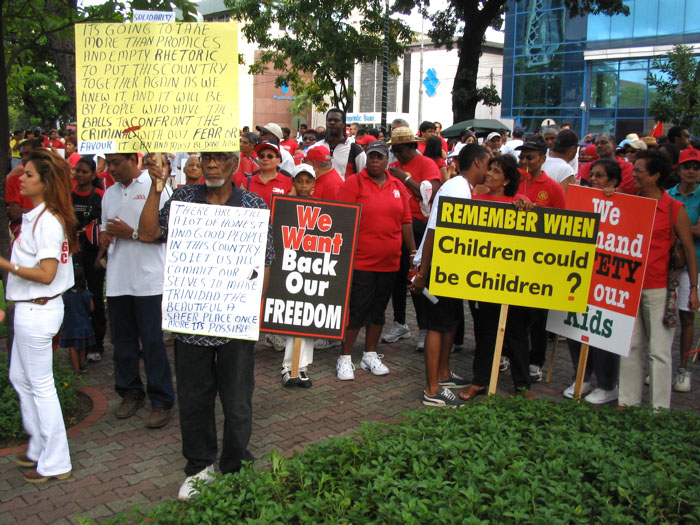
More than three years have passed already since the Saturday morning in October 2005 when thousands of Trinidadians marched through the streets of Port of Spain to protest the Manning government's failure to deal with spiralling murder and kidnapping rates, widespread public anxiety, and the profound social inequalities behind these.

I was there. I walked from Independence Square up Henry Street, across Duke Street, down Frederick Street to Woodford Square. Outside the Red House three hundred volunteers dressed in white lay down on a long sheet of red cloth, representing that year's tally of murder victims to date. I talked to dozens of people, asked them why there were there, what they were feeling. They were angry. We were angry. It seemed the whole country was finally angry enough to trigger a political revolution of some kind--not a revolution of guns and bombs, but one of responsibility and accountability and democracy.

Less than a month later, on 16 November, the Trinidad and Tobago football team qualified for the World Cup. It was a wonderful thing to experience the explosion of sheer joy that rocked the country that afternoon. Again, I was there. I walked down Ariapita Avenue and Western Main Road through deliriously celebrating throngs. We were happy. We forgot how angry we had been just a few days before. For a few blissful hours, it was wonderful to forget.

We forgot too well.

It is time to get angry again.

Thursday, November 13, 2008

"If that person's person outweighs his babble...."

You may well want to ask--Is not every person a valid person? And I say: Yes. I say yes only if that person's person outweighs his babble in the war against the reduction of himself, because every word or deed a person utters or commits which fails to recognise or increase the value of another ends up by effecting a reduction of the provenance of the intention.

-- Martin Carter, address at the University of Guyana's eighth Convocation Ceremony, 1974

(This person's person feels slightly more valid this evening after reading some Carter, listening to some Bach, and sipping some Campari on the rocks.)

Sunday, November 09, 2008

"Bang on the gates and demand to be heard"

Andre Bagoo, writing in today's Newsday:

“If ever I am aggrieved by anything the media does in the future, I am going to the courts,” Manning said. But why didn’t he go to the courts in the first place? That was and is his right as a citizen of this country and he has exercised that right in the past. Why did the Prime Minister ignore the rule of law by his actions? Instead of driving for miles into Port-of-Spain, why did he not just pick up a phone and make a call to complain? Or write a letter? Or complain to the Media Complaints Council? Or call for the implementation of the Telecommunications Authority of Trinidad and Tobago (TATT)’s draft broadcast code. TATT, which is established by an act of Parliament, has included a clear and concise complaints provision in the draft. The Prime Minister is aware of all of these options.

You see, if you have a grievance, there is a procedure. That procedure ensures law and order. For this reason, no citizen of this country, no matter how aggrieved by anything the Prime Minister does, can drive up to La Fantasie, bang on the gates and demand to be heard.


(Maybe we should?)

Saturday, November 08, 2008

Invalid persons

So on 25 October, just four days after Reporters Without Borders released its 2008 Press Freedom Index--in which Trinidad and Tobago slipped eight places down from our 2007 ranking--Mr. Manning took such visceral offence to the on-air comments of a couple of radio journalists that he swooped down upon the 94.1 FM office, with all the security detail commesse that prime ministerial dignity apparently requires, to make a personal complaint to the station management. The two journalists were swiftly suspended.

What were the vicious and scandalous comments that so roused Mr. Manning's righteous ire? Today's Express helpfully publishes a transcript. They had the nerve to--drumroll--criticise the government's gasoline pricing policy, and mock Mr. Manning's suggestion that cars be converted to run on CNG.

Prime ministerial dignity, it seems, is a delicate and fragile thing. Mr. Manning was "aggrieved", he said. His rights as a citizen were trampled on. Worse, this kind of criticism by the media, Mr. Manning said at a press conference two days ago, could even bring the country to its knees:

... too many of the commentators either in the newspapers, or in the media or on the radio, do not respect our institutions. It is a question of being disrespectful to institutions and authority, and pursuing a course of action that could cause the image of these institutions and individuals to be tarnished in the minds of those in whose interest they are set up to serve, and therefore they could become completely non-effective. That is the risk that we run.

Never mind that many citizens would say the institutions and individuals of the Manning government are already "completely non-effective" at solving the real and urgent problems facing the country. Forget the murder rate, the babies dying in hospitals, the near-permanent gridlock of the country's transport infrastructure, the power outages and water lock-offs, the widespread belief in massive corruption and fraud at high levels of government, the secret new constitution now being drafted that will consolidate executive power, etc etc etc etc. What we really need to worry about, Mr. Manning seems to believe--and he even seems hurt that we don't agree--is a free press.

The Media Association of Trinidad and Tobago and the Trinidad and Tobago Publishers and Broadcasters Association have rightly--and forcefully--objected. Today's Guardian and Newsday run strongly worded editorials criticising Mr. Manning's stance. Georgia Popplewell at Caribbean Free Radio has weighed in. Taran Rampersad at KnowProSE lists his concerns in an open letter to the prime minister.

But the real question here is even more fundamental than freedom of the press and all citizens' freedom of expression. In a letter printed in today's Express, C. Peters says: "It may do Mr. Manning well to remember that prime ministership is leadership and not ownership." In her column in today's Guardian, Attillah Springer makes a similar point:

We can't imagine ourselves ever as anything else but good slaves, doing massa's bidding. We can't bear the threat of the threat of massa's whip coming down on our backs.... We can't be anything that is not expected of us. Loyal servants, with ready smiles and words of praise.

Mr. Manning's radio station raid is yet one more reminder--as if, Lord, we needed another--that in Trinidad and Tobago democracy is not a practice but a concept, and a concept that we still, forty-six years after independence, do not really understand, much less believe in. In a representative democracy--the form of government we claim--the people's representatives, our members of Parliament, and the prime minister chosen from among them, have the duty of acting in the people's interest. Instead--with the help of a constitution which already concentrates too much power in the executive's hands, a system of tribal politics that is destructive of clear thought, and a succession of politicians enamoured of the trappings of power--we are lorded over by an administration which seems to believe it is the people's duty to act in the government's interest.

Mr. Manning has demonstrated over and again his disdain for criticism--however useful, however well meant--whether it comes from the media, the public at large, or even from within his own party. The 94.1 incident is perhaps not even the most serious example we've witnessed of late. I have no doubt that the Trinidad and Tobago media, backed up by their regional colleagues, will face down Mr. Manning's threats of personal and legal action against journalists by whom he feels "aggrieved". But who among us is facing up to the bigger and deeper crisis, the bankruptcy of "democracy" as a meaningful idea and principle and practice in twenty-first-century Trinidad and Tobago?

Because we are all responsible.

More than three decades ago, Martin Carter summed up his social and political ideal for the Caribbean as "a free community of valid persons."

I have never in my life felt so pessimistic about us merely understanding this ideal, much less achieving it.


Tuesday, November 04, 2008

A Change Is Gonna Come

I was born by the river in a little tent
Oh and just like the river I've been running ever since

It's been a long, a long time coming

But I know a change gonna come, oh yes it will


It's been too hard living but I'm afraid to die

'Cause I don't know what's up there beyond the sky

It's been a long, a long time coming

But I know a change gonna come, oh yes it will


I go to the movie and I go downtown

Somebody keep telling me don't hang around

It's been a long, a long time coming

But I know a change gonna come, oh yes it will


Then I go to my brother

And I say brother help me please

But he winds up knocking me

Back down on my knees


There been times that I thought I couldn't last for long

But now I think I'm able to carry on

It's been a long, a long time coming

But I know a change gonna come, oh yes it will

Sunday, November 02, 2008

Yeah.

Tuesday, October 21, 2008

Apologia Pro Vita Sua, ch. 1

He was irresistibly drawn to lost causes.

Sunday, October 19, 2008

I am on the wrong side of the world.

Saturday, October 11, 2008

Saturday, September 27, 2008

There are no ideas in my head, only words.

Wednesday, July 23, 2008

Three cheers for Mark Bittman.

Saturday, July 19, 2008

"Savages rarely murder new-comers"

Qualifications for a Traveller. -- If you have health, a great craving for adventure, at least a moderate fortune, and can set your heart on a definite object, which old travellers do not think impracticable, then--travel by all means. If, in addition to these qualifications, you have scientific taste and knowledge, I believe that no career, in time of peace, can offer to you more advantages than that of a traveller....

[Health--check. Craving for adventure--check. Moderate fortune? Um.... Definite object? Yikes.]

Reputed Dangers of Travel. --A young man of good constitution, who is bound on an enterprise sanctioned by experienced travellers, does not run very great risks. Let those who doubt, refer to the history of the various expeditions encouraged by the Royal Geographical Society, and they will see how few deaths have occurred; and of those deaths how small a proportion among young travellers. Savages rarely murder new-comers; they fear their guns, and have a superstitious awe of the white man's power: they require time to discover that he is not very different to themselves, and easily to be made away with. Ordinary fevers are seldom fatal to the sound and elastic constitution of youth, which usually has power to resist the adverse influences of two or three years of wild life.

[No worries then.]

-- Francis Galton, The Art of Travel, or Shifts and Contrivances Available in Wild Countries, 5th edition, 1872

Wednesday, July 16, 2008

"We are not the first"

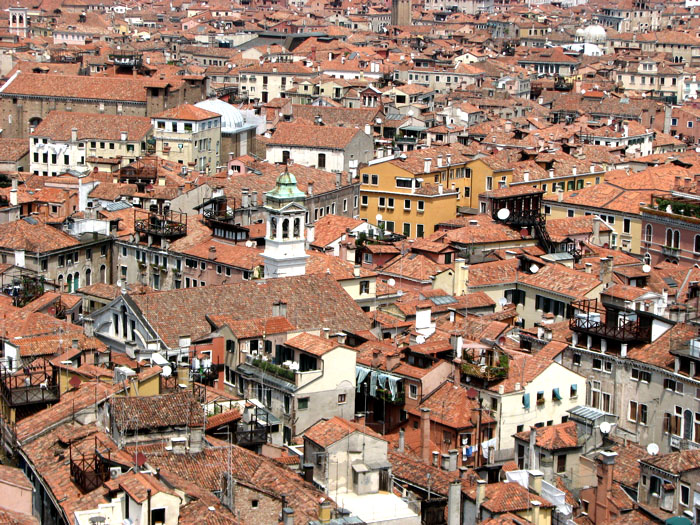
roofs of venice

View across the rooftops of Venice, looking roughly westwards from the Campanile of San Marco; 5 July, 2008

"The first thing we notice once we reach the top, is that there are no canals to be seen. We are not the first to make this surprising discovery.... It is mildly irritating to find that this ... has been noticed by almost every previous traveller to Venice. We must get used to sharing our feelings and discoveries with travellers of the past."

-- J.G. Links, in the introduction to his great Venice for Pleasure

Wednesday, June 04, 2008

Four duppies

The silk cotton tree--called the ceiba in the Spanish Caribbean--is traditionally associated with duppies and jumbies, spirits who inhabit its vast, buttressed trunk, and who exact their revenge on anyone foolish enough to take an axe to the tree, or otherwise inflict damage.

On the island of San Andres--a little fragment of Jamaica that broke off and floated towards Nicaragua, and now belongs to Colombia--there is a small freshwater lagoon that locals call Big Pond. Not far from the lagoon is an ancient silk cotton tree with a hollow trunk, big enough for a dozen people to stand inside.

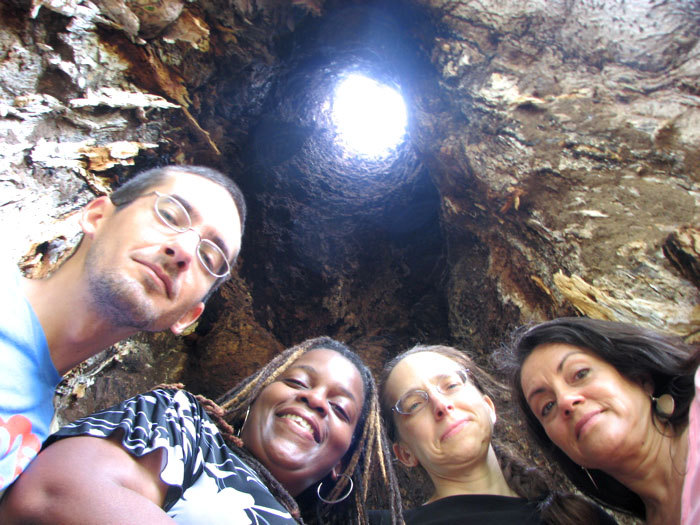
There were just four of us there that day, last Friday, playing hooky from the Caribbean Studies Association conference. We hopped in a taxi and let the driver give us an improvised tour of the island. At Big Pond we met Francisco, who lives nearby and serves as a tour guide for the lagoon and caretaker for the placid, near-tame caiman who bask on its banks. He took us to see the old silk cotton tree, its top snapped off by a storm a few years ago, but new branches and leaves sprouting everywhere; he posed us inside the hollow trunk and artfully photographed us with the sky shining through the broken trunk far above.

four csa duppies

That's me on the left, of course; then Andrea Shaw, of Nova Southeastern University; Leah Rosenberg, of the University of Florida; and Ivette Romero-Cesareo, of Marist College. A magazine editor and three literary scholars, standing in for the duppies of Big Pond. We left with handfuls of small yellow mangoes and went in search of Morgan's Cave.

Friday, May 09, 2008

In my thirty-third year

I read maybe eighty books--including The Road to Oxiana and Explosion in a Cathedral and The Brief Wondrous Life of Oscar Wao--and some I liked better than others. I wrote many thousands of words, of which about thirty-four thousand were printed in various places, and who knows how many appeared online. I wrote about 240 blog posts, here, there, elsewhere. I edited four issues of the CRB and finished working on a new edition of V.S. Naipaul's early family correspondence. I took about four thousand photos. I listened to lots of John Coltrane and Miles Davis and Ella Fitzgerald and Anita O'Day. I wished jointpop would start playing their old songs again. I drank nearly four hundred cups of coffee (mostly Blue Mountain), and maybe as many glasses of wine; more than a thousand cups of green tea, and five or six caipirinhas. I ate the best pizza I've ever eaten. I spent ten weeks or so abroad and visited five countries; eleven art museums; three cathedrals; one opera house. I slept three nights in a hammock. I climbed Blue Mountain Peak with Brian. I hiked a very brief stretch of the Appalachian Trail. I swam in the Rupununi River and watched the sun set from the brink of Kaieteur. I crossed the Equator for the first time. I spent a sybaritic long weekend in Treasure Beach with Georgia and Annie. I slept on one Chris's sofa in New York and another's in Hanover, NH. I strolled across the Mississippi with Marlon and back again. I got lost in a bioluminescent lagoon with Joanna and Dan. I went back to Karanambo, and they remembered me. I went to the Lethem Rodeo with Alastair and Jonathan. I followed Fitzcarraldo to Manaus. I made seventeen trips by aeroplane, two by train, one by overnight bus. I bought new hiking shoes, a trekking pole, a map of the Amazon Basin; a black velvet blazer and two pairs of black-and-white-striped socks; the wrong kind of cough syrup in Boa Vista; a subscription to Artforum; four (unsigned) Boscoe Holder drawings. I was appointed the 2007 Rex Nettleford Fellow in Cultural Studies. I set up my own website. I used Facebook to check up on various old and hopeless crushes. I found myself at Alice Yard many Friday nights. I played J'Ouvert in a costume made from recycled insulation foil. I joined a reading group. I made my first clafoutis. I tried to save the Boissiere House, and don't yet know if I succeeded. I buried my dog Marlo. I learned to say "I don't speak Portuguese" in Portuguese. I stopped watching TV. I worried, and doubted, and longed. My shortsighted eyes got a little worse. My heart beat thirty-eight million times.

Saturday, May 03, 2008

Number 19

It’s World Press Freedom Day today, and I guess some of us would love to boast at the fact that Trinidad and Tobago is the only English speaking Caribbean country to be in the top 20 of the World Press Freedom Index (we’re number 19). Even UK is number 24 and the USA is number 48.

I’ve been thinking about this number 19 status. How we ended up there. Do we really have press freedom or is it just that nobody takes the media seriously enough to think of anything that gets published or broadcast as a threat to their authority or their profit margins?


--Attillah Springer, in her column in today's Trinidad Guardian.

Friday, May 02, 2008

The view from Tihuanacu


Tihuanacu, Bolivia; photo by Cristina Quisbert


"Part of our history written on stone...."

(Via Rising Voices.)
Vive le roi

Us being a monarchy and Mr Manning, the king, explains our situation completely. It doesn't matter whether the plains upon and forests within which the peasants live flood in the wet season and burn in the dry; once they pay their tax -- an X marked in the right box every five years -- they are as dispensable as the cannon-fodder dispatched to the front lines to purchase, with their piled cadavers, sufficient cover for the Big Push.

Neo-monarchy explains all the failures of Trinidad & Tobago a real republic would not tolerate but which we accept as conditions. We can even live with (or die by, according to postal address) our one-a-day murder rate without worry, since all who do not swear loyalty to the king cannot expect his protection; if you don't vote PNM, you can't expect a police service. (For an explanation of the king's failure to protect the PNM's own voters, see "cannon-fodder" supra.) Get a PNM party card and the kingdom is open to you. Prove yourself a hard worker for the ordained cause and, next morning, in your mail, you will find two invitations, one to the next black tie opening featuring the Divine Echoes (established since 2007 by Royal Patent) and another to bid for the contract to supply meals to the Chinese workers dredging Charlotteville Bay, damming the Caroni River or paving the Queen's Park Savannah (according to the whim of Duke Calder Hart).


--B.C. Pires is a badjohn Bagehot in today's Express.